Contact
XNew Novel Pre-release Announcement: “A Desperate Measure,” Book 2 of “The Cain Series,” Coming June 2024
I am pleased to announce that A Desperate Measure, book 2 in The Cain Series, will be published this June, 2024, in ebook, trade paperback, and hardcover formats. A Desperate Measure, like its predecessor Ethos of Cain, is an episodic, near-future, cyberpunk, science fiction novel, which continues the story of Cain and Francesca, as they struggle against corporate, governmental, and criminal forces, each intent upon plundering the seawall project that Francesca had risked so much to launch.
Cover copy:
“In A Desperate Measure, book 2 of The Cain Series, several months have passed since Cain and Francesca took down the fascist cabal of billionaire Dietrich Stinnes. Riding the wave of celebrity that her victory had inspired, Francesca stepped down as the Mayor of Venice to join the newly-formed European Seawall Foundation, to shepherd the project she had fought so hard to create, with Cain at her side as her Chief of Security. What should have been a blissfully dull—though vitally important—assignment soon became as dangerous as any period in their lives, when off-world corporation Black Horizons, Inc. infiltrated the ESF, intent upon diverting a portion of the foundation’s staggering budget to their bottom line—by any means necessary.
Cain must soon return to his roots in corporate crime, to counteract BHI’s attempts to neutralize Francesca. From circumventing the surveillance-state AI, to battling mercenaries on the streets of Brussels, to hunting corrupt cops through a deserter colony on the Latvian coast, Cain struggles to intercept each new—and increasingly aggressive—threat. BHI, however, have nothing to lose through violent escalation: they are a sovereign corporation, their orbiting headquarters placing them not only above Earth, but above its laws, as well.
Faced with the crippling effect that BHI’s extortion would have on the seawall project—and with the hundreds of millions who would suffer famine without the new farmlands it would create— Francesca must decide if times have grown desperate enough for a desperate measure.”
Where Ethos of Cain was told in five parts, A Desperate Measure is told in three, with the multilayered, character-and-plot-driven story exploring the consequences of sovereign orbitals, the surveillance state, AI, and the depths of corruption. Book 3 in The Cain Series, which is already underway, will return to the five-part format and explore the evolving characters of Cain and Francesca, as the series races toward a pivotal complication.
I want to send out a big thank you to all the readers who have enjoyed Ethos of Cain and hope that you will equally enjoy A Desperate Measure. I plan to release the cover art next month, followed by the novel’s publication in June.
Until then, happy reading!
“Ethos of Cain” featured on SFWA’s Insta
Ethos of Cain, book 1 of The Cain Series, was recently featured on the official Instagram of the Science Fiction and Fantasy Writer’s Association (formerly known as the Science Fiction Writers of America). Here’s a link to their “First Lines Friday” post: https://www.instagram.com/p/C3bJe5LSSFD/. There was a second post, as well, featuring the cover art from Ethos of Cain along with three phrases describing it, “Three Phrase Thursday,” they call it, but those posts are a part of an “Instagram Story” and apparently are not available in perpetuity. Oh well (the three phrases were, “Raw fusion-powered cyberpunk,” “With gritty infiltrator action,” and “And one hell of a romance, too;” there was a character limit of some sort, which made for an interesting writing challenge).
If you have Instagram and are looking for your next favorite book, the SFWA’s account may be the perfect addition to your feed. They post content throughout the week from the authors of sci-fi, fantasy, cosmic horror, and related genres, everything from “Mascot Monday,” where you can meet the pets of your favorite authors, to “Writing Desk Wednesday,” for a peek at where the magic happens, to “Three Phrase Thursday,” and “First Lines Friday.” And if you find a book you like, the posts are usually linked back to the author’s accounts, if you want to add them to your feed, too.
I’ve never been much for social media, not since I was a boy sneaking computer time at a friend’s house or the school library, to delve into the forbidden wonders of BBS culture. Following a youth filled with “Anarchy Philes” and homemade flamethrowers, detailed instructions on how to run a phone-card scams (which went over my head), and recipes for things like thermite (which never worked), today’s social media seems (thankfully) tame by comparison. It’s probably for the best, though I imagine you can still find those thermite recipes if you really wanted to. As for the celebrity gossip and state actors hurling propaganda, well, I think I’d rather spend my time writing my next novel.
Speaking of which . . .
Sex and Violence
Anyone who has read my novels will have found plenty of sex and violence, from protagonists dodging CIA assassins on the streets of Cairo, to love requited for a married woman and the man she couldn’t have, to battling orcs or exploring undercover kink or walking balls-out into a room full of fascists to save a lover or die trying, I have written a hell of a lot of sex and violence. A fundamental question to writing such scenes, however, is: what makes an action or love scene good? Or, conversely, what takes a violent set piece or sexual episode and drags it into tedium? Surprisingly, the exact same things.
Despite sex and violence largely representing two opposites—that is, creation and destruction (with exceptions, of course; martial arts, for instance, are violent yet creative)—effectively writing either requires the same approach, challenging writers to avoid the same pitfalls. It is all too easy, when launching into an action sequence or walking a pair (or more) of protagonists back to the bedroom, to focus on the mechanics of the situation, to become lost or bogged down in depicting rather than storytelling. The solution, fortunately, is the same for these sorts of scenes as it is for all others: focus on the reader. When I approach such scenes, I ask myself, how will it move the plot forward and what knowledge—about the characters, their arcs, their capabilities, vulnerabilities, etc.—will the reader gain from the telling? If the scene I envision doesn’t move the plot or tell us something new about the characters, deepening the readers’ insights, then I either change it or cut it.
So, what does that look like on the page? Let’s start with sex. Imagine a hardboiled detective from the 1940s and his acid-blonde torcher client returning to his office after a night of trying to get the skinny on a movie producer who stole her inheritance. Classic. They hadn’t found much at the clubs they had visited, except for one clue. They talk it over, decide what to do, and then the dick makes a pass at the blonde and, for once, she doesn’t slap his face. The clothes come off, a long scene depicting genitals in action commences, and, when it ends, the blonde lights up a coffin nail, throws on her clothes, says, “thanks for the drink, mac; I’m going for a massage; pick me up at eight,” and the dick wonders where he’s going to find a clean shirt.
Does this sex scene succeed? No, it doesn’t; no matter how erotic or inventive the genitals-in-action catalogue, we, as readers, know nothing more about the characters than we did beforehand and the plot hasn’t moved: the detective and client still only have the one clue, their feelings for one another haven’t changed, and we haven’t learned anything about their personalities, where they’re going or why. So, what would make the scene effective? Change it so that the detective wants to drop the case, that he doesn’t think the clue is worth it and that he’s worried about the three other cases he supposed to solve; then, have the blonde seduce the detective, to keep him interested and working the case. Why does this scene work where the sex-for-fun scene largely does not? It works because now we know more about the characters and the plot: we lose confidence in the clue and, as readers, start looking at other investigative avenues; we also know more about the detective, that he’s worried about his other cases, that he’s willing to drop a client if the case has little potential, and that he’s a bit of a sucker; we also learn that the blonde is willing to do anything, isn’t too romantic in her opinions about sex, and that maybe she’s hiding something, if she still thinks there’s a case when the facts don’t support it. In short, the second version works because it is a part of the story and the first one doesn’t work because it is extraneous. Now, could the second version be written with a catalogue of genitals-in-action? Sure. Would it hurt it? Well, that’s largely a matter of taste, both the writer’s and readers’. If the blow-by-blow account (pun intended) doesn’t illustrate the character’s state of mind or intentions, etc., then the readers may wonder why it is there. Pandering rarely succeeds.
Action scenes also need the same focus on characters and plot and can fail when they focus too much on mechanical sequences and gore. Consider: our detective has uncovered the blonde’s true motive behind the investigation, to locate her polygamist husband and rub him out; unfortunately for the detective, the husband, and his second wife, the blonde has tailed him to the husband’s new home and is armed with tommy gun. The blonde opens up on the house, blowing out the front windows; the husband and wife drop to the floor and are showered with glass; the dick barely gets off a couple rounds from his revolver, hitting nothing. The blonde kicks in the front door and lets off a long burst to her left, nearly decapitating the dick, who dives behind a steamer trunk that he hopes has something more solid in it than linens. The blonde then swings back to the other direction, roars in fury, and shoots the husband, catching him in the shoulder; he stumbles back, crashing into the China cabinet, and then the blonde opens up full-auto, riddling his torso with fifty rounds of hot lead, punching through his lungs, exploding blood out of his mouth in his last desperate breath. As the husband’s bloody corpse slips to the floor with a sound like a butcher slapping hamburger into wax paper, with his new wife screaming until her throat bleeds, the blonde turns her fury and her sub-machinegun on the other woman. The dick sees that it’s now or never, pops up over the steamer trunk, and puts a round from his revolver straight through the back of the blonde’s head, shattering her skull and spewing grey matter over the remains of the China.
Does this scene work, even as a finale? It does not. Clichés to one side, it fails because of its focus on blood and guts and the mechanics of the scene, rather than on the people enacting it. With the exception of the word “fury,” we have no real insight into the blonde’s motivations, what she feels—if anything—in that long-awaited moment of revenge. All we get, instead, is the sequence of her assault on the house, which might be okay if there were obstacles to overcome rather than elongating “she entered the house,” followed by a description of the husband’s death that receives as many words as the rest of the scene. Could it be salvaged? Sure. If the focus of the scene is instead changed to the people enacting it, rather than just the events, it could work, particularly if it is the finale. If the blonde has to employ tactics and patience, pinning down the detective until he runs out of ammunition, it would show that her fury runs cold, is calculated, and may satisfy the readers’ predictions about the blonde, developed from earlier scenes. If the husband tries to shield his new wife or push her out of the room, it deepens his character beyond being a cad who couldn’t be bothered to divorce one (admittedly intense) wife before marrying another; we’d care just a little bit more about him. If, after fighting her way into the house, the cold and calculated blonde begins to shed tears as she kills the husband, it would reveal something other than the baser instincts of ownership or propriety, signaling that even the femme fatale has a beating heart somewhere inside. Again, what makes a sex or violence scene work is its contribution to the plot or to our understanding of the characters.
Are there exceptions? You bet. Sometimes a sex scene or a scene of violence is a species of celebration. If the plot of the book (or show or movie or whatever) is or involves a “will they or won’t they” arc, where we, the readers, wonder if those two crazy kids will ever get it together, then the sex scene where they finally do get together celebrates, in a way, their plot’s success. It can be taken too far, of course, but a little salaciousness in that moment constitutes the payoff for the readers’ emotional investment in the characters. Again, focusing on the character’s joy in such a scene, their experience, will save it from seeming awkward. If the reader comes away feeling as though they just witnessed the writer masturbating in public, yeah, you’ve failed. Keep it in your pants, fella. And, of course, the same can be true for action scenes: the final defeat of the BBEG calls for a little explicit description, a payoff for the readers who, hopefully, have come to dislike Mr. Big Bad. And, of course, like the celebratory sex scene, it can be taken too far: if the specificity of the kill or the duration of its description gets out of hand, the reader may feel that they are reading the writer’s confession about a hated, personal opponent, rather than the protagonist’s. As T.S. Eliot wrote in Tradition and the Individual Talent, “The progress of an artist is a continual self-sacrifice, a continual extinction of personality,” by which Eliot meant that we, as writers, should keep our prejudices out of our works and, instead, focus on giving the work what it needs to succeed. You, as a human being, may have really hated your kindergarten teacher, but the detective isn’t shooting her for you: he’s shooting the blonde to protect wife number two—and the scene will be better if it stays that way.
To sum up: scenes of both sex and violence succeed when they move the plot forward and show us something about the characters. That is, after all, why we write them in the first place.
My Top Five Cyberpunk Novels List Now Appears on Shepherd.com
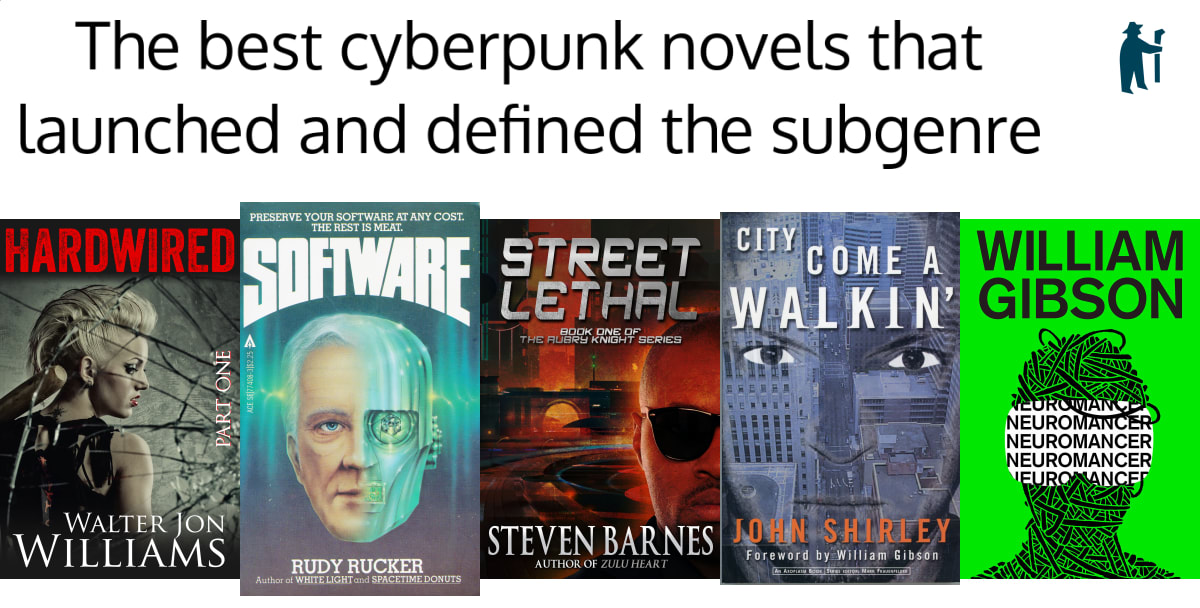
To coincide with the launch of Ethos of Cain, I collaborated with the folks at Shepherd.com to create a new recommendation list: The best cyberpunk novels that launched and defined the subgenre. If you haven’t been to their site yet, Shepherd is a book recommendation source—with a twist. Rather than aggregating users’ lists, Shepherd collects recommendations from authors: each list includes one recent work by the author and then five works that the author loved or that inspired their work or contributed to a genre, a moment in history, or other interest.
You can find my Shepherd list here: https://shepherd.com/best-books/cyberpunk-that-launched-and-defined-the-subgenre
I chose to focus on the golden-age cyberpunk novels, starting with City Come A-Walkin’ by John Shirley—cyberpunk’s “patient zero,” as William Gibson calls him—and continuing through the subgenre’s first years of existence. These are great books, not only enjoyable and thought-provoking to read, but important to the history of cyberpunk and science fiction, generally.
Shepherd has other cyberpunk-related lists, too, which you can find here: https://shepherd.com/bookshelf/cyberpunk. And, of course, lists on any other genre or subject you might want to explore, by authors you know or may discover for the first time.
I hope you enjoy The best cyberpunk novels that launched and defined the subgenre list and Ethos of Cain.
Happy reading!
New Novel Release, “Ethos of Cain” by Seth W. James, Book 1 of The Cain Series
Ethos of Cain, the first novel in The Cain Series, debuts today exclusively on Amazon, in ebook, trade paperback, and hardcover formats. An episodic, near-future, cyberpunk science-fiction novel, Ethos of Cain explores a world in the grip of technological upheaval, the nature of identity and change, and the ever-widening grey area between criminal, corporate, and governmental power.
Cover art and back-cover copy:
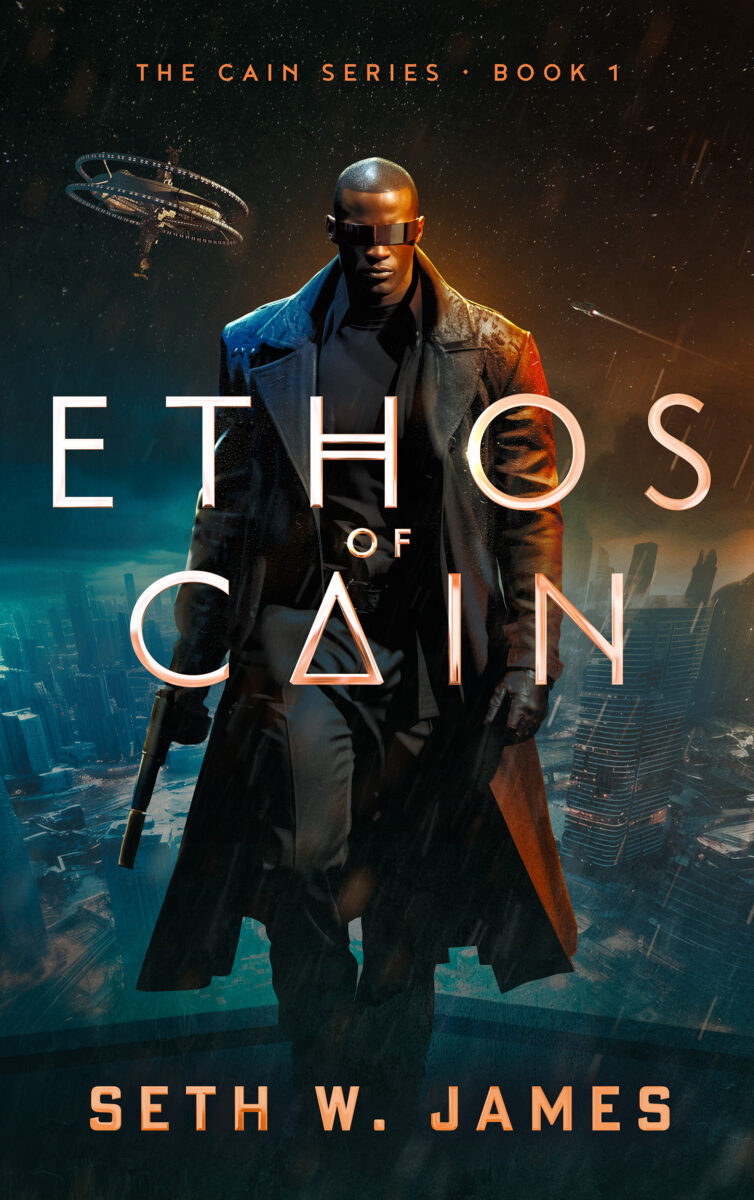
“The perfection of cold fusion and CasiDrive propulsion had lifted humanity into the wider solar system—and widened the gulf between the nameless masses and the sovereign-class wealthy. Into the grey between corporate and criminal walked Cain, a soldat de fortune, who, for the last twenty years, had taken scores and completed contracts for the elites of any world, impenetrable, abstruse, and solitary.
All of that changed one year ago when, after a triste with a former client turned into a romance, Cain’s relationship with Francesca caused him to question how he could walk in her world and survive in his own. The boundaries of their lives then came crashing to Earth when the man whose syndicate they had destroyed returned for revenge. The money behind the man, however, concealed a deeper, more sinister plot, one that threatened Francesca’s life and would challenge Cain to walk the razor’s edge between their two worlds while remaining true to the Ethos of Cain.
Ethos of Cain is the first novel in The Cain Series by Seth W. James.”
The Cain Series will follow Cain and Francesca as they delve into the deepest underworlds and soar to the farthest flung colonies to challenge the powers of the next century, to wrest from them a future worth living. Set in the near future, where the perfection of cold fusion and CasiDrive propulsion have lifted humanity into the wider solar system, the series explores the collision of boom-industry expansion, the worsening effects of climate change, and the warring-states corporate power structure created by sovereign orbitals.
It has been a great pleasure writing the first novel in The Cain Series and designing the next several books to come. Book 2 is already underway and I hope to have it ready for publication by next summer or early fall, 2024.
Thanks for reading and I hope you enjoy Ethos of Cain!
Cover Art Pre-Release for “Ethos of Cain,” Book Launch September, 2023
Here is a sneak peek at the cover art for my new novel, Ethos of Cain, which comes out this September, 2023.
The artists at Damonza delivered again with a great cover. I had a rough idea of how the cover should look, with a ton of small details that could link to the text, and Damonza just took those elements and ran with them. They actually returned four awesome covers for the first round, each a masterpiece in its own right, before working with me to refine the image into what you see above. I couldn’t be happier with it, either. In my mind’s eye, this is what I saw while writing Cain. The orbital looks fantastic, too.
Anyway, hope you enjoy the cover art. Only a month to go before the release of Ethos of Cain. See you then.
New Novel Pre-release Announcement: “Ethos of Cain,” September 2023
It gives me great pleasure to announce that my twelfth book, a novel entitled Ethos of Cain, will debut this September, 2023, exclusively on Amazon in ebook, trade paperback, and hardcover formats. Ethos of Cain is an episodic, near-future, cyberpunk science fiction novel that follows the eponymous character, Cain, through high-stakes contracts as a soldat de fortune, explores his growing romance with Francesca, the Mayor of Venice, and delves into the substance of identity as he struggles to balance the disparate aspects of his life while remaining true to the Ethos of Cain.
The back-cover copy:
“The perfection of cold fusion and CasiDrive propulsion had lifted humanity into the wider solar system—and widened the gulf between the nameless masses and the sovereign-class wealthy. Into the grey between corporate and criminal walked Cain, a soldat de fortune, who, for the last twenty years, had taken scores and completed contracts for the elites of any world, impenetrable, abstruse, and solitary.
All of that changed one year ago when, after a triste with a former client turned into a romance, Cain’s relationship with Francesca caused him to question how he could walk in her world and survive in his own. The boundaries of their lives then came crashing to Earth when the man whose syndicate they had destroyed returned for revenge. The money behind the man, however, concealed a deeper, more sinister plot, one that threatened Francesca’s life and would challenge Cain to walk the razor’s edge between their two worlds while remaining true to the Ethos of Cain.
Ethos of Cain is the first novel in The Cain Series by Seth W. James.”
The inevitable question arises, after penning a story such as Ethos: is this the beginning of a series? It gives me even greater pleasure to answer, yes, it is the first novel in The Cain Series.
I had not employed the episodic format since Shadow Over Odiome, despite really enjoying the challenges and opportunities it offers; but Ethos of Cain’s story so naturally fit the episodic format that the novel seemed to select it more so than the author. I can’t say that I will employ it exclusively for the series—we’ll have to see where Cain and Francesca go, the sorts of trouble they get into—but it may become the default format for the Cain books.
Anyway, stay tuned! I plan to release the cover art as soon as it is available, followed by the release announcement.
Thanks for reading!
Reader as Artist
Every reader is an artist. When approaching a novel or series, an old favorite or new recommendation, we of course think of the long hours of artistic labor that the author devoted to crafting the prose, but the artistry does not cease when the author’s pen lifts from the page: writing requires reading, to complete the artistic act, and every reader performs an artistic act while reading. As writers, we plot plots and craft images, we decide what the characters say and when, and we allude to the works of the past as we create the those of the future: as readers, though, we are the ones who give voice to the characters’ words, perhaps hearing an accent unmentioned in the prose, we clad the characters in our mind’s eye, to suit our interpretation of such a person’s style, and we make the skies weep or the leaves crackle underfoot, as we follow the characters through a world of someone else’s devising and our creation. As readers, we start with the author’s words and then create our own version of the story in our minds as we read.
Writing and reading are unique in this way, when compared to other artistic media: the audience of a novel actively create as they read, while in other media, the experience is largely passive. From sculpture to painting to performance of every variety, the audiences are given the exact substance to consider, whether it is an actor’s costume or a singer’s cadence. And there’s nothing wrong with that. I love movies! But when watching a movie, I don’t dress the characters or set, I don’t apply tone to their voices, nor expression to their faces. All is provided. Certainly audiences can engage with movies, wondering if a character can be trusted or if the heroes will escape in time, the interaction, though, is not artistic but rather it is social. We consider the characters and the scene, we anticipate or disbelieve, just as we would in our daily lives with those we meet in our travels. We do not, however, create.
And it is for this reason that overly descriptive prose can hamper a reader’s experience, rather than heighten it. Novels can, of course, possess a cinematic quality (my Pyrrhic Rendition is quite cinematic), but when an author adopts the provide-everything sensibility of the movies or other media, they deprive the reader of one of the fundamental benefits of reading: the act of creation. Raymond Chandler said it succinctly—and with a simile, of course—in his The Long Goodbye, when he wrote about the tendency of tough-guy villains to speak only in exit lines, “It’s like playing cards with a deck full of aces: you’ve got everything and you’ve got nothing.” It’s the same with overly descriptive prose, if, as writers, we describe everything to within an inch of its life, we not only leave no room for the reader, we can soon find ourselves on a three-page jag expounding about wainscoting.
The trick, therefore, is to leave room for the reader to create. If a description or action is not central to the plot or a character’s arc, consider whether it would be better to leave that detail for the reader to create. Trace the clothes or the trees, but leave the reader to color them; name the song and the tune, but leave the singing to the reader’s mind; cloud over the skies, but leave the reader to fill up the puddles. After all, in your mind’s eye, you may see Lauren Bacall as you create your femme fatale, but the reader may prefer Rita Hayworth. Let the reader cast whom they will and their experience will be all the more satisfying.
Leaving out details can test an author’s willpower; many of us can see the scenes and hear the sounds so vividly in our minds as we write. I always go back to a passage from the Tao Te Ching, when struggling to decide what to cut:
Thirty spokes share the wheel’s hub;
It is the center hole that makes it useful.
Shape clay into a vessel;
It is the space within that makes it useful.
Cut doors and windows for a room;
It is the holes which make it useful.
Therefore benefit comes from what is there;
Usefulness from what is not there.
Write what will benefit the reader and leave out what will be useful for them to create. Happy reading!
Y the W
In relaunching my author website and updating my book covers, I had the opportunity to return to my original byline of Seth W. James, restoring the W after many years of absence. It had been my intention while penning my first novel to include my middle initial, if for no other reason than to help disambiguate which is my first name and which is my last. Despite the widespread familiarity with actor Brion James, author Henry James, and outlaw Jesse James—to name only three of the many notable Jameses—I’ve been Mr. Seth’d on numerous occasions and, with resignation, have answered to James simply to extricate myself from those apparently unfamiliar with Seth as a first name. (I really ought to see if Seths Green, Meyers, and Rogen want to start a union; The International Society for the Heightening of Awareness that Seth is a Given Name; bit of a mouthful, really.)
During the last years of the 1990s, however, I was busy writing my first novel—an impenetrable crime noir masterpiece, so dense that even I couldn’t understand it, reading it many years later—when one of former President George Herbert Walker Bush’s sons decided to enter the next election: to disambiguate himself a bit from his father, he went by George W. Bush. Damn it. I was leery at that point of including my W, as it might give the wrong impression that I shared more than an initial with a fascist who, even before the election had begun, had indicated his intention to invade Iraq. After the Supreme Court appointed him President and he stumbled his way to a response to the awful events of September the eleventh—a response that included torture, disinformation, and war—and with those praising or lambasting his crimes, foibles, and general incompetence referring to him often simply as W, I thought it best to quietly remove my middle initial before embarking on my writing carrier. So, after rewriting my first novel four times—to ensure no one could possibly understand it—I sent it off to literary agents simply bylined with Seth James.
With worse dictators and their enablers having taken the stage since, and with no punishments having been applied the Ws of yesterday—ensuring, as we now see, that no crime is out of consideration and that the terrorists of the Republican Party will stop at nothing to destroy the United States of America—the country seems to have largely forgotten George. I understand he spends his time painting, now; I would have thought wallpaper would have been more apropos, but nevertheless. And so, as I gear up for my next literary salvo, focusing on the issues of climate change and inequality, painting my own pictures of the future, wherein Earth’s ability to sustain human life has waned while oppression has waxed, I have reaffixed my W. A terribly minor point from a terribly minor author, perhaps, but it is my name. And so, it is with my full name that I’ll see you on the bookstore shelf, I hope, and we’ll wander together through a troubled future.
Seth W. James
SethWJames.com is live
My new author website, SethWJames.com, is finally live and I couldn’t be happier with it. It has been a long road, from identifying the resources I would need, to screening the potential creators who could deliver them, to bringing them together (well, my web designer brought them together, really) in time to launch before the holiday season, with all its advertising fervor. Launching a new author website takes as much time, energy, and passion as writing a novel. I hope visitors are as pleased with the end result as I am. It was hardly a single effort, of course, and so I thought for this, my return to blogging for the new site, that I would give credit where credit is due and thank the many artists who helped to make SethWJames.com a reality.
I am fortunate to be a member of the Science Fiction Writers of America (also doing business as the Science Fiction and Fantasy Writers Association) and, when I finally mustered the energy to undertake relaunching my author website, I naturally visited the SFWA’s author resource channels and discussion boards to see what I would need and, hopefully, pick up some useful advice. With a little digging, I found all that I needed and recognized that I would have to enlist a few other creators to achieve what I had envisioned. For an author website to do what it needs to do, it has to showcase to readers what the author has written, it has to provide news outlets and similar entities with author bios and photos, and it has to facilitate communications: to achieve those ends, therefore, I would need a photographer, a cover designer, and a web designer.
It’s the indispensable and often most embarrassing resource for any author: the author photo. We all need them, to put on the dust covers of hardbacks, to show website visitors that we are, in fact, human beings (of particular importance to science fiction writers, as there’s always a bit of suspicion where we’re concerned), and for the occasional biographical piece, if you are lucky enough to get one. For independent authors like me, there is the temptation to use that one selfie you took, which for some reason you’re unshakably proud of, but—and it is a sad truth to face—that selfie is, in fact, awful. It’s just awful! And worse than it not presenting you, regardless of your appearance, in the best light possible, it just doesn’t look professional. If readers come away feeling that you could not be bothered to have a proper photograph taken, why should they believe you’ve invested every last ounce of energy in your writing? That’s why it’s best to go to a talented photographer who will do the job right. For me, that artist was Celestina Ando and she did an amazing job.
Celestina has a studio off Bloomfield Ave in Montclair, NJ, just down from the Wellmont Theater, and she was great to work with, very passionate about photography and very present and encouraging to her subject, who in this case was not the most graceful of models. Celestina is a pro’s pro, creating not only beautiful photographs but also providing expert advice, both to clients and through her lectures. Just take a look at her website and you’ll see that Celestina can do it all, from classic portraits to edgy chiaroscuro to even adding a bit of suave to the photos of grumpy old novelists. If you click over to the press kit page on SethWJames.com, you’ll see the full photo shoot there. I couldn’t be more pleased with what Celestina was able to create.
While photos are important, the first thing readers will see, however, is not the back of the book, but the front, which is why I knew that relaunching my author website and brand would not succeed unless I updated my covers. The old idiom, you can’t judge a book by its cover, certainly has its place, but where readers are concerned it might as well be flat wrong: a great cover may not guarantee a great book, but a bad cover will guarantee that readers won’t pick it up. As an author, you have about one second, at most, to interest a passing reader, whether it’s on the bookstore shelf or in the infinite scroll online: if you can convey not only the essentials of genre and plot, but that you invested the time, energy, and—it has to be said—the money into creating a professional, attractive cover, the reader may just pause long enough to read a few words. At that point, it is entirely up to you, the author; but for the covers, go to Damonza.
Damonza is the leading design company in the cover, formatting, and collateral space and has been for many years. The praise I saw around the SFWA for Damonza was well earned, as the experience working with them to create my new covers was excellent. Whether you are a fellow independent author or published by one of the Big Four—and Damonza works with both—it is entirely natural to feel a bit of trepidation about another artist representing your work, which of course is unavoidable where covers are concerned unless you are also an illustrator or digital artist. The great people at Damonza made the process as pleasant as possible, with constant communication—which is so important, you’re never left wondering, never in the dark—and by asking the right questions about my books and what I had envisioned for their covers. They provided me with several options and even the potential covers that I did not select were excellent (it was a tough choice, particularly, for Shadow Over Odiome, as both of the finalists met my expectations in different ways). In the end, I’m thrilled with the covers they’ve created and wound up calling on several of their other services, including interior formatting and the creation of the banner for SethWJames.com.
With all the preparation lined up and underway, I next went in search of the most fundamental artist needed to launch SethWJames.com and that was, of course, the web designer. Hamiltro is one of the leading website design companies in Manhattan, creating everything from powerhouse ecommerce sites to simple, elegant author websites. Like the other artists above, Rohesia at hamiltro was very hands-on, very engaged and invested in getting the vision right for SethWJames.com. We collaborated several times, kicking around ideas and making sure that we were on the same sheet of music, before Rohesia delivered the first, early version of the site, just showcasing functionality. From there, once the other assets were created, she dived into the style and esthetic of the site, building the wonderful blend of form and function you see today. The communication was constant, the advice was expert, and the end results speak for themselves. While anyone can buy a domain and slap together a free WordPress template, it takes a professional to build a site that is lightning-fast, bold, clean, and easy to use. With hamiltro, that’s just what I got. As I said at the beginning, it has been a long road to finally reach a place where I feel that my work is properly showcased, that the enormous care, effort, and time that I have invested in each of my novels and stories are conveyed in the second-and-a-half a reader might take to glance their way. It took the efforts of many artists to achieve this goal and to them I say, thank you. And to the readers who visit SethWJames.com, I hope that you enjoy what all of our hard work has created. Thanks!