Contact
XCover Reveal for “An Uncalculated Risk,” book 3 of “The Cain Series,” Launch Date May 2025.
Here is the cover art for An Uncalculated Risk, book 3 of The Cain Series, which is due out this May, 2025.
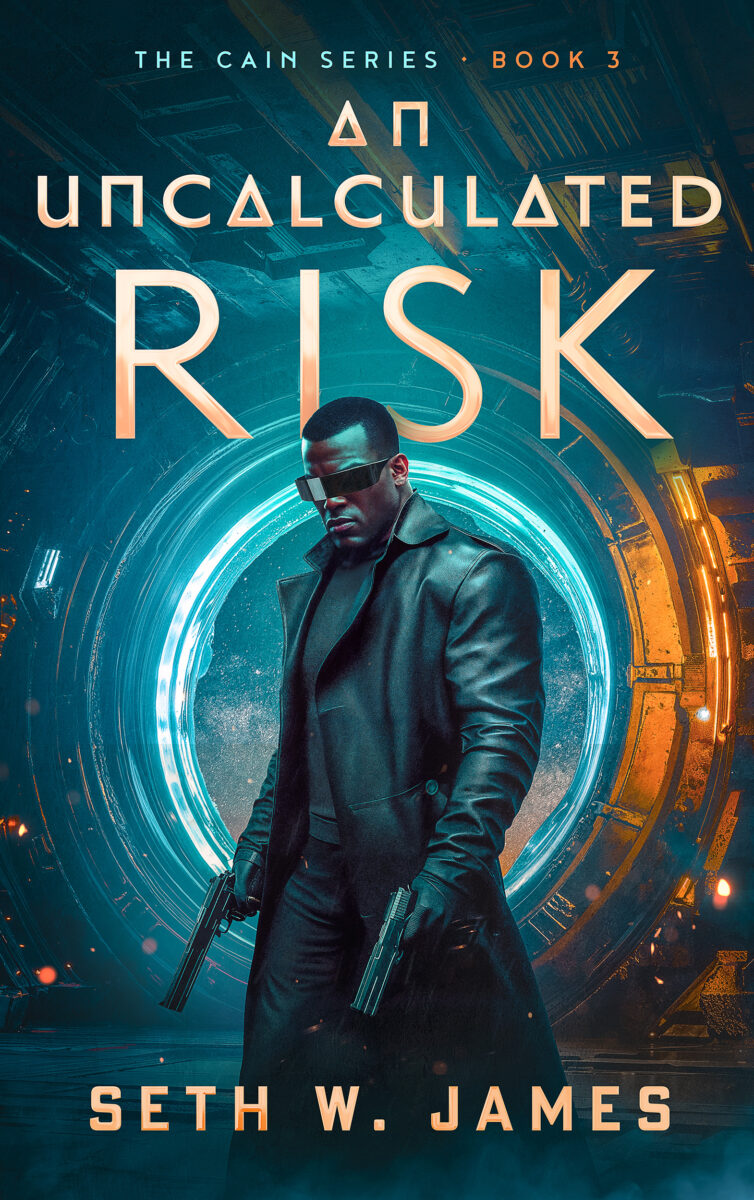
The covers just keep getting better in The Cain Series. This is the sort of cover I grew up seeing in bookstores, on the sci-fi, fantasy, and crime novels I usually perused (didn’t always have the funds to buy, it’s true, but you’d be surprised how much reading you could get done before they chucked you out). They’re like little movie posters. So often, these days, I see very basic, kind of drab, covers: a symbol, maybe, some design or other to break up the background color, and then your standard, readable font for the title. One of the joys of being an indie novelist is that I don’t have to settle for the safe, boring covers that the big 4’s marketing bros would demand. I get the good stuff.
Anyway, An Uncalculated Risk is due out in May, while book 4 is still on track for publication later this year. A two-for, for 2025. See you in the stacks.
New Novel Pre-release Announcement: “An Uncalculated Risk,” Book 3 of “The Cain Series,” Coming May 2025.
An Uncalculated Risk, book 3 of The Cain Series, will publish this May, 2025, in ebook, paperback, and hardcover formats. Like all Cain Series novels, An Uncalculated Risk is an episodic, near-future, cyberpunk, science fiction novel. In this installment, Cain and Francesca travel to South America to uncover the monstrously wealthy force behind a mercenary invasion of Bolivia, which has disrupted their tin exports and, consequently, Francesca’s seawall project. Nothing is every as it seems, though, and the cat-and-mouse of spycraft soon escalates to armed conflict.
Back-cover copy:
“In the fusion age, war for commerce had become a commonplace. But when an unusually well-financed mercenary force seized the Alto Madidi mining complex in the Bolivian Andes, they set off a cascade of events that brought the global tin market to its knees—and threatened Francesca Pieralisi’s seawall project. Tin was indispensable to the manufacture of construction exoskeletons, called “connies,” and connies were the only means by which the seawall could be built, to reclaim the farmlands that would stave off the looming threat of famine.
To discover who had hired the mercenaries—and to determine if their goal was simply theft or an attack on EU interests—EU INTCEN tasked Francesca (and, with her, Cain) to go to Bolivia and find the truth. What they found was a plot by the richest man on Earth—or off of it—and a global extortion conspiracy involving bribery, kidnapping, and war. Francesca, undaunted by the odds, would stop at nothing to save her seawall project, but soon found herself betrayed by her own zeal, manipulated into compromising her reputation and career, and saw her life pushed to the cliff’s edge.
Cain must now fight through a web of off-world, sovereign corporations, conspiracies and counter-conspiracies, to make a lie the truth, and to pull Francesca back from oblivion. From Sovereign Trade Zones in the American South to the rainforests of South America, Cain battles not only to remove the mercenary brigade, but to short-circuit the machinations of a trillionaire in An Uncalculated Risk, book 3 of The Cain Series.”
Like Ethos of Cain, book 1 of The Cain Series, An Uncalculated Risk is told in five parts, as Cain and Francesca pursue one clue after another, hunting down those responsible for the invasion. I’ll release the cover art next month—and it’s a good one, too—followed by publication of the novel in May.
As a special sneak preview, An Uncalculated Risk will likely NOT be the only Cain Series novel published in 2025. I’m on track to have book 4 in the series ready for publication by the end of the year. Whether that means late November or early December remains to be seen; there are several factors involved, including cover creation, proofreading, typesetting, etc, and any one of them could suffer a delay. I’ll have a better idea by summer’s end and will post another update on book 4 then. For now, I’d like to say thank you to every reader who has enjoyed—and especially to those who took the time to review, always massively appreciated—Ethos of Cain and A Desperate Measure. I hope you will check out An Uncalculated Risk this May.
Stories within Stories: The Episodic Form and Novel Cycles in “The Cain Series.”
Introduction:
With the new year upon us, and with the publication of book 3 of The Cain Series coming at the end of spring, I wanted to take some time to discuss the series’ structure and format and how they might impact readers’ speculations about the series’ direction. Some readers have already reached out with their theories about what will happen next (with most people keying off of the first and last lines of A Desperate Measure), and I wanted to pour a little fuel on that fire.
The Episodic Form: a primer
All books in The Cain Series are and will be episodic, near-future, cyberpunk science-fiction novels. But what does “episodic” really mean and how do episodic novels differ from more traditional books?
At its most basic, an episodic novel is one where the story is told through a series of separate, though related, parts that add up to something more than a collection of shorter stories, when viewed as a whole. There are several different modes common to episodic fiction (as well as novels that don’t fit nicely into any), with most employing either linear—where each part follows the previous one and leads toward the book’s conclusion—and non-linear—which either tells a story out of sequence or explores a particular theme rather than combining to an overall story; either mode might also employ the same characters throughout or not.
A few familiar examples of episodic fiction may be found in the works of Charles Dickens and Alexandre Dumas. Many of the first episodic novels were the result of serialization, where Dicken’s and Dumas’s novels’ parts were first printed in periodicals, coming out over a series of months. In more recent times, Steven King used the same serializing format for his novel, The Green Mile. With serializing, each episode needs to stand more or less on its own, as readers will not have the luxury of moving immediately on to the next part of the story; so, each part needs to engender enough satisfaction for readers to anticipate—and return for—the next part. Serialized novels are typically linear.
Another classic example, which was not serialized (well, part of it was), is James Joyce’s Ulysses. Ulysses is told chronologically, though not strictly speaking in a linear mode. Though we ostensibly follow Poldy and Stephen around Dublin as they meet people and get into trouble, the book’s episodes do not tell an action-plot story (more on that to come), but rather discuss and exemplify the themes of alienation and yearning.
The episodic form is certainly not restricted to novels, of course: television shows are inherently episodic, as are some movie series. The original Star Wars trilogy is an example of an episodic series (and not simply because each movie is given an episode number in its prologue), telling the story of Anakin Skywalker’s redemption. Readers will also find the episodic form used in plays, musicals, operas, comics, graphic novels, and other media.
In The Cain Series, I employ the linear episodic form, where each part of each book follows its predecessor, but I have also further refined the form by applying classic dramatic structure to the parts, both internally and at the novel and series levels. Now what the hell does that mean?
Classic Dramatic Structure
Dramatic structure is a way of arranging the parts of a story—whether episodic or not—to make it more effective, engaging, and sensible. And whether you have received specific training in dramatic structure (e.g. a degree in literature, drama, or film) or not, you are, in fact, an expert in it—because it is used absolutely everywhere. Classic dramatic structure has its roots in ancient Greece, where plays were offerings to the gods, but is more commonly known by Gustav Freytag’s definition of the five-act structure. Freytag called the five acts introduction, rising action, climax, falling action, and resolution. I don’t know that these definitions speak as effectively to contemporary readers today as they may have in 1863, so I tend to translate them thus: in act 1, we meet the characters and maybe learn a little about the world of the story; in act 2, we learn more about the world and, importantly, the situation or problem that the story will confront; in act 3, the protagonist sets out to do something and usually hits a snag of some sort toward the act’s end (the complication); in act 4, the protagonist overcomes the complication (or not, if the story is tragic) and then, in act 5, we reach the denouement, or the wrap-up of the story.
In addition to the five-act structure, there is its refinement, the three-act structure, which we have all seen in countless movies and TV shows. The three-act is quite similar in structure to the five-act: in act 1, we meet the characters and learn what it is that they want to do; in act 2, they try to do it and hit a complication; in act 3, they overcome the complication (or not) and then wrap things up with the denouement.
Now, this may all seem pretty darn formulaic—and it is—but that does not have to mean boring. Oh, it absolutely can result in a boring story, regardless of medium: I’m sure we’ve all experienced numerous stories where we have anticipated the entire thing in the first few pages or minutes and find ourselves bored nearly to death by the tedious predictability of it all. That anticipation, which undermines us in bad storytelling, however, is the product of our expertise with dramatic structure: if we did not know how it all works, we would not anticipate it so accurately. That same expertise of ours, though, can be called upon by good writers to create tension, suspense, to inspire our imaginations as we wonder what the complication will be or how the heroes will overcome it—or not—or even if the story will have a happy or tragic ending. As with so many things in life, it all comes down to the execution.
In The Cain Series, I employ dramatic structure on three levels, with the first, obviously, appearing at the part level (levels two and three to come, a little further down). Each individual part of each book is discrete, that is standalone; they usually follow a three-act structure, though sometimes a five, and tell a self-contained story. For example, part 1 of Ethos of Cain sees Cain breaking into von Hauer’s villa on Paradise Orbital, to extort him out of stock that Lester needs to take over Arcadia Planitia, on Mars: in part 1 of A Desperate Measure, Cain tracks a stalker through a maze of streets and AI limitations.
Now, as Ethos is told in five parts and Desperate is told in three, both of these parts do not have the luxury of space that a traditionally structured novel would. Though it complicates the writing process (episodic ain’t for the timid), structuring the novels this way also produces a number of advantages, too.
Advantages of the Episodic Form
There are several distinct advantages to employing the episodic form, the first of which is speed. As every critic and reader’s review has stated, The Cain Series novels are fast-paced. This is a result of each part’s size and discrete nature, that is, its requirement to reach a satisfying conclusion within a limited space. In a five-act structured novel like Ethos of Cain, each part is roughly the size of a novelette; for a three-act structured novel like A Desperate Measure, each part is roughly the length of a novella. In both cases, each individual part needs to tell its story quickly—or I’ll run out of space. So, out of necessity, Cain Series novels enjoy a lightning-fast pacing (I say enjoy, but obviously that depends on the reader; if you enjoy fast pacing, you may enjoy The Cain Series; if you do not, you almost certainly won’t).
The next advantage is that each part of each novel is action-packed. Since each part is discrete, it comes with its own complication and resolution, and in a kick’em-in-the-teeth, cyberpunk, action-adventure story, that usually entails someone getting fucked up. And so, in each part, readers will find a corresponding action sequence. Now, writing a series of action-packed episodes does require some finesse and consideration. If every action sequence has the same level of danger, the same scale, and the same stakes, the book will quickly become tedious and predictable. Raymond Chandlier said it best, as is so often the case: “it’s like you’re playing cards with a deck full of aces: you’ve got everything and you’ve got nothing.” If, however, we go back to our classic dramatic structure for a cue, we can employ rising action, that is, increase the stakes, the scale, and the danger as the novel progresses, helping to keep the action fresh and exciting.
The third major advantage to the episodic form is the simplification of complex plots. When you have a complicated plot, such as what appears in A Desperate Measure, with a trillion-euro government project (the seawall), the avarice of a sovereign corporation (BHI), and the corruption of an official (spoilers!) raging out of control, it can often lead to the plot bogging down in the details or the readers becoming impatient with elements that do not seem terribly exciting. By taking such a plot and breaking it down into its component pieces, however, readers are only ever asked to acquire a little bit of knowledge at a time, with the rest of the prose dedicated to plot and characters. Again, for example, part 1 of A Desperate Measure introduces us to the surveillance AI and the seawall project, while focusing on Cain’s cat-and-mouse conflict with the stalker; these elements, though—the project and the surveillance AI—are fundamentally important to understanding parts 2 and 3. And so, even though each part’s plot is discrete, subsequent parts of the book benefit from the knowledge acquired in the previous parts. By the time readers come to the act 3 climax, they already possess the presuppositions necessary to enjoy it—Serval blind spots, exoskeletons, sovereign-orbital money laundering—but without ever having to slog through pages and pages of slowly-paced exposition.
There is also an additional benefit to the episodic form employed in this manner, which is seen at the book-level (the second level), rather than at the part level, and that is the melding or mingling of action- and character-driven plots.
Plots, Plots, Plots:
Though plots come in many forms and styles, they can usually be characterized as either an action-driven plot or a character-driven plot. The basics: an action-driven plot revolves around what the characters do (e.g. Cain fighting his way into a hidden research facility to steal a quantum field generator), while a character-driven plot concerns what the characters think, feel, and who they are, their identities. Most novels, regardless of format or structure, are either one or the other, though—like yin and yang—also usually contain a bit of the other. The bit of the other, though, is usually a subplot, that is, something minor that takes place alongside the main plot. In your typical romance novel, for instance, the character-driven plot is often a “will they or won’t they” plot, resolved by the protagonists getting together in some way (or not), while there is also an action-driven subplot (e.g. a terminally ill spouse, a big project at work, etc) that may act as an instigating moment for the lovers. Subplots, however, never get as much space and are never as important as the main plot; if they were, they’d constitute the main plot. Except, of course, in episodic fiction.
In Cain Series novels, with three to five discrete plots per book, a mix of character-driven and action-driven plots can be found, along with subplots involving either. Take part 3 of Ethos of Cain for an example: the action-driven plot involves Cain performing two rescue missions—Odhiambo’s and Walker’s—with their juxtaposition illuminating Cain’s character (i.e. what he will do versus what he will not); there is also a romantic, character-driven subplot involving Cain’s relationship with Francesca, about how his constantly risking his life is stressing her out, making life intolerable. But, though each of the five parts of the novel employ action-driven main plots, the book’s main plot is character-driven, a “will they or won’t they” plot resolved by Cain and Francesca discovering a way to live their two very different lives together.
And this facet of The Cain Series novels brings us, finally, to stories within stories, because the book’s plot amounts to an additional story, beyond the five stories told by the five parts.
Stories within Stories:
Though each part of a Cain Series novel tells a discrete story, it also performs a double-duty, in that each part also constitutes an act in the novel’s structure. In Ethos of Cain, part 1 tells its own story, yes, but it also fulfills the overall book’s need for an act 1, introducing the main character, Cain, and a few important facets of the world. Part 3 is also a self-contained story, while simultaneously providing the novel with its act-3 complication, which is (spoilers!) Francesca breaking things off with Cain. In part 3’s plot, Francesca’s choice to end things creates a tragic end, but in the novel, her choice creates the complication that the two of them must overcome. By structuring the parts and novel in this way, by writing Cain Series novels with multiple, discrete stories and having them combine to tell an additional fourth or sixth story (the book’s), the same exact words on the page tell multiple stories at the same time.
So, in Ethos of Cain, the parts each tell an action-driven story about Cain’s life as a soldier of fortune in the near future, while—combined—they tell a character-driven story about his identity, his sense of self, and whether he can maintain his idea of who he is, his character and dignity, while somehow changing enough to continue his life with Francesca.
The stories-within-stories told by each novel, however, go further still, in that the individual novels also play an additional role, similar to how their component parts do, by contributing to yet another, even larger story (the third level). I call these multi-novel stories “novel cycles.”
Just as each part of each Cain Series novel contributes an act to the novel’s structure and story, each Cain Series novel does the same, contributing an act to the novel cycle’s structure and story. A novel cycle, therefore, works much the same way as the novels that compose it: three or five novels taken together will tell an additional, larger story.
Now, with book 3 not due out until late spring, 2025, we have yet to see a complete cycle—but it’s on its way.
I’m sure many readers will be able to deduce the first cycle’s story once book 3 comes out (actually, a few have already done so, just on the basis of books 1 and 2), but as a little nudge to the imagination, I will say that the first cycle of The Cain Series novels is composted of the first five books; thus, each of the first five novels tells both its own story and contributes an act to the first novel cycle (i.e. book 1 is act 1 for the cycle, book 2 is act 2 for the cycle, etc). Knowing what we now know (or already knew) about classic dramatic structure, readers may very well anticipate the stories that books 4 and 5 will tell, once they have finished reading book 3 and recognize the novel cycle’s complication. We shall see.
Beyond the first novel cycle, the plan at the moment is for books 6, 7, and 8 to comprise cycle 2, followed by books 9 through 13 comprising cycle 3. That isn’t set in stone, not just yet, but as I have already outlined those cycles, it will likely play out that way. More to come on those cycles once we’ve completed the first.
Conclusion
“But, Seth, my dude, do I really have to know all this stuff about structure and episodes and all that jazz, just to enjoy these books?”
You don’t, no. This is just a little insight into how the series functions. Like any other literary technique—foreshadowing, literary allusion, extended metaphor, personification—the point isn’t to wow audiences with the author’s staggering genius (well, that’s not my goal, anyway), but to tell a great story. Just as a driver doesn’t need to know how the car’s engine is made or works, how many times the ABS pumps the breaks when decelerating, nor the revolution ratios for the differential—not just to drive the car and enjoy its acceleration, safety, and handling—the same is true for a good book: you don’t have to know that a conflict is coming up soon because of the structure; if done well, you’ll feel it anyway, in the characters’ voices, in the too-quiet of an alleyway, because nothing is that easy. If you are into literary technique, though, just like a car guy is into cars, then, by all means, have a poke around under the hood of The Cain Series. These novels are built to last.
In a future update, I will discuss the role of technology and technological revolution in the series theme—and then, a little later on, a new theme that will begin, probably with book 9. Until then, I hope you will find new and deepened enjoyment in The Cain Series and will check out book 3, this spring.
Happy reading!
“Ethos of Cain” Featured on the “Discourse” YouTube Channel; Plus, Special Bonus: Book 3 Update!
Ethos of Cain, book 1 of The Cain Series, was recently featured on the book-review YouTube channel, Discourse. You can watch it here: https://youtu.be/v_iqgwbMpqk?si=AVa4wuj6Ijrtab__
It’s a nice review—quite flattering, in fact, as they were impressed by the dialogue, fast pacing, and action sequences—but the presenters only really covered part 1 of Ethos. They try to keep these videos to about 15 minutes, so I guess they ran out of time before hitting the other 4 parts to the book. Oh well, more for new readers to discover!
In other news, I am pleased to report that I have completed the first draft of book 3 of The Cain Series. This latest episodic, near-future, cyberpunk, science fiction novel sees Cain and Francesca drawn into a massive international and transorbital conspiracy, involving war in South America, global politics, commodities market manipulation, and, of course, bold and breathtaking action. It doesn’t have a title yet (well, it does, but not one I’m ready to release at this time), but it does have a tentative release date: 1 June 2025. So, now is the perfect time for Santa to stuff a few cyberpunks’ stockings with Ethos of Cain and A Desperate Measure, to get caught up before book 3’s publication in the new year.
Thanks and happy reading!
Congratulations to the 3 Book Clubs that Won Free Copies of “Ethos of Cain”
Three lucky book clubs just won free copies of Ethos of Cain.
The clubs all use BookMovement.com to organize their activities, including a shared bookshelf to keep track of what they’ve read or will read, a calendar with invite functionality to facilitate their meetings, email reminders, and much more. If you haven’t heard of it before, BookMovement is the premier book club site (with associated app), having just celebrated its 20th anniversary, and hosts more than 83,000 book clubs. It offers a lot of fun features like discussion questions and recommendations between clubs, but it also offers book giveaways, where clubs bid on an author’s newest work and, if their bid wins, they receive a free copy for each member of their club. A lot of authors, whether indies like me or trad-published, find BookMovement a great way to connect with avid readers, people for whom books are not just a bit of fun (which they are), but a way of life.
Congratulations again to the three wining book clubs that received free copies of Ethos of Cain.
The Reviewers Have Spoken: “A Desperate Measure,” book 2 in “The Cain Series,” is “fast paced,” “high-octane”, and “sexy.”
The reviews are in for A Desperate Measure, book 2 in The Cain Series, and I couldn’t be more pleased. Let’s take a look.
The first review is from Booklife by Publisher’s Weekly:
“Full of jaw-dropping plot twists and high-octane action, A Desperate Measure is a riveting adventure that explores a futuristic world swarming with visionary technology—and a new set of rules”
A thoroughly satisfying review, A Desperate Measure earned an A in each of the categories judged by Booklife.
The next review is from Kirkus Reviews:
“A sharp, sexy high-tech adventure . . . Cain and Francesca’s dialogue crackles with chemistry, whether they’re bantering over a candlelit dinner or planning a quick escape from rogue military operatives gunning for their lives.”
A good review, overall, which pays particular attention to the deepening relationship between Cain and Francesca. Kirkus’s verdict: get it!
And lastly, a review from Readers’ Favorite:
“A Desperate Measure is fast-paced with a lot of action . . . I recommend this book to readers who enjoy thrillers, intrigue, and social issues.”
And who doesn’t? I like reviews from Readers’ Favorite because they come from actual readers, people who love books and can’t get enough.
So, there we are, a few glowing reviews for A Desperate Measure. How do you like this most recent installment in The Cain Series?
As for book 3 in the series, it progresses as expected, on pace for a summer 2025 publication. Until then, I hope you enjoy A Desperate Measure. Happy reading!
New Novel Release, “A Desperate Measure” by Seth W. James, Book 2 of “The Cain Series”
A Desperate Measure, the second novel in The Cain Series, comes out today on Amazon, in ebook, trade paperback, and hardcover formats. An episodic, near-future, cyberpunk science-fiction novel, A Desperate Measure continues the story of soldat de fortune Cain and former mayor Francesca Pieralisi, as they struggle against corporate, governmental, and criminal forces, each intent upon plundering the seawall project that Francesca had risked so much to launch.
Cover art and back-cover copy:
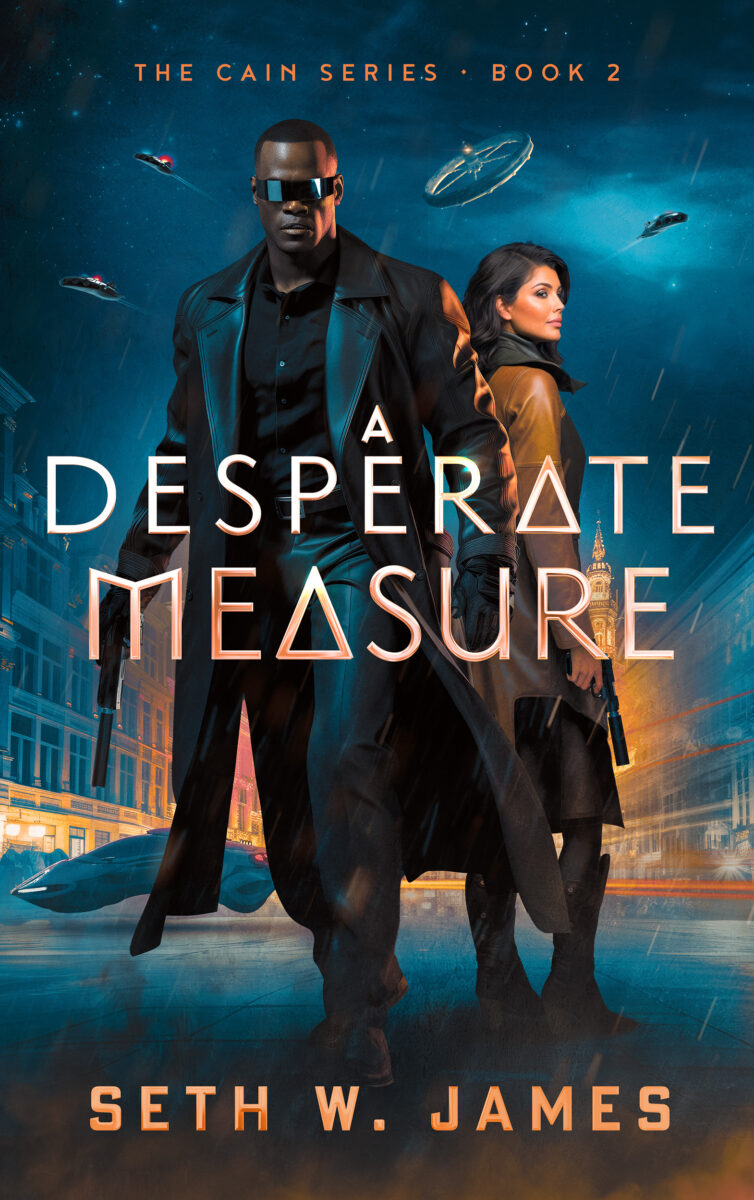
“In A Desperate Measure, book 2 of The Cain Series, several months have passed since Cain and Francesca took down the fascist cabal of billionaire Dietrich Stinnes. Riding the wave of celebrity that her victory had inspired, Francesca stepped down as the Mayor of Venice to join the newly-formed European Seawall Foundation, to shepherd the project she had fought so hard to create, with Cain at her side as her Chief of Security. What should have been a blissfully dull—though vitally important—assignment soon became as dangerous as any period in their lives, when off-world corporation Black Horizons, Inc. infiltrated the ESF, intent upon diverting a portion of the foundation’s staggering budget to their bottom line—by any means necessary.
Cain must soon return to his roots in corporate crime, to counteract BHI’s attempts to neutralize Francesca. From circumventing the surveillance-state AI, to battling mercenaries on the streets of Brussels, to hunting corrupt cops through a deserter colony on the Latvian coast, Cain struggles to intercept each new—and increasingly aggressive—threat. BHI, however, have nothing to lose through violent escalation: they are a sovereign corporation, their orbiting headquarters placing them not only above Earth, but above its laws, as well.
Faced with the crippling effect that BHI’s extortion would have on the seawall project—and with the hundreds of millions who would suffer famine without the new farmlands it would create— Francesca must decide if times have grown desperate enough for a desperate measure.”
I thoroughly enjoyed writing book 2, particularly as the deepening relationship between Cain and Francesca provided an opportunity for plenty of banter. Further exploring the implications of a technology boom (in this case, the fusion boom) upon society, its laws, and the functioning of government led to a fascinating cascade of challenged preconceptions and exploded expectations, which will no-doubt continue throughout the series. Book 3 is underway and will see Cain and Francesca take on their most powerful adversary yet.
Thanks for reading and I hope you enjoy A Desperate Measure.
Cover Art Pre-Release for “A Desperate Measure,” Book 2 of “The Cain Series,” Launch Date June, 2024
Here is a first look at the cover art for my new novel, A Desperate Measure, book 2 of The Cain Series, which comes out this June, 2024.
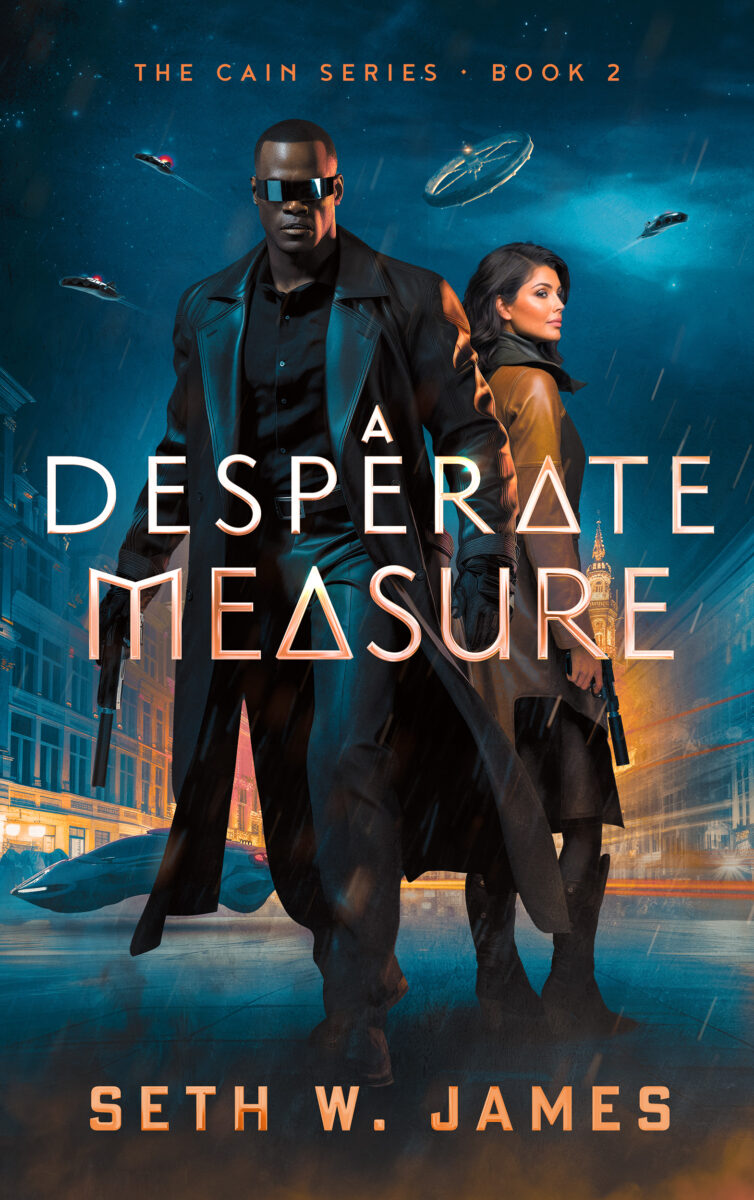
Another terrific cover from the artists at Damonza. Not only does Cain look even better than he did on the cover of Ethos of Cain, but they did a great job introducing Francesca, appearing for the first time. Francesca will likely grace some of the covers of The Cain Series, though not for every book; Cain’s adventures may require solo action, occasionally, and the covers will reflect that distinction. All in all, though, I am very pleased with the new cover art and can’t wait to see it in print.
New Novel Pre-release Announcement: “A Desperate Measure,” Book 2 of “The Cain Series,” Coming June 2024
I am pleased to announce that A Desperate Measure, book 2 in The Cain Series, will be published this June, 2024, in ebook, trade paperback, and hardcover formats. A Desperate Measure, like its predecessor Ethos of Cain, is an episodic, near-future, cyberpunk, science fiction novel, which continues the story of Cain and Francesca, as they struggle against corporate, governmental, and criminal forces, each intent upon plundering the seawall project that Francesca had risked so much to launch.
Cover copy:
“In A Desperate Measure, book 2 of The Cain Series, several months have passed since Cain and Francesca took down the fascist cabal of billionaire Dietrich Stinnes. Riding the wave of celebrity that her victory had inspired, Francesca stepped down as the Mayor of Venice to join the newly-formed European Seawall Foundation, to shepherd the project she had fought so hard to create, with Cain at her side as her Chief of Security. What should have been a blissfully dull—though vitally important—assignment soon became as dangerous as any period in their lives, when off-world corporation Black Horizons, Inc. infiltrated the ESF, intent upon diverting a portion of the foundation’s staggering budget to their bottom line—by any means necessary.
Cain must soon return to his roots in corporate crime, to counteract BHI’s attempts to neutralize Francesca. From circumventing the surveillance-state AI, to battling mercenaries on the streets of Brussels, to hunting corrupt cops through a deserter colony on the Latvian coast, Cain struggles to intercept each new—and increasingly aggressive—threat. BHI, however, have nothing to lose through violent escalation: they are a sovereign corporation, their orbiting headquarters placing them not only above Earth, but above its laws, as well.
Faced with the crippling effect that BHI’s extortion would have on the seawall project—and with the hundreds of millions who would suffer famine without the new farmlands it would create— Francesca must decide if times have grown desperate enough for a desperate measure.”
Where Ethos of Cain was told in five parts, A Desperate Measure is told in three, with the multilayered, character-and-plot-driven story exploring the consequences of sovereign orbitals, the surveillance state, AI, and the depths of corruption. Book 3 in The Cain Series, which is already underway, will return to the five-part format and explore the evolving characters of Cain and Francesca, as the series races toward a pivotal complication.
I want to send out a big thank you to all the readers who have enjoyed Ethos of Cain and hope that you will equally enjoy A Desperate Measure. I plan to release the cover art next month, followed by the novel’s publication in June.
Until then, happy reading!
“Ethos of Cain” featured on SFWA’s Insta
Ethos of Cain, book 1 of The Cain Series, was recently featured on the official Instagram of the Science Fiction and Fantasy Writer’s Association (formerly known as the Science Fiction Writers of America). Here’s a link to their “First Lines Friday” post: https://www.instagram.com/p/C3bJe5LSSFD/. There was a second post, as well, featuring the cover art from Ethos of Cain along with three phrases describing it, “Three Phrase Thursday,” they call it, but those posts are a part of an “Instagram Story” and apparently are not available in perpetuity. Oh well (the three phrases were, “Raw fusion-powered cyberpunk,” “With gritty infiltrator action,” and “And one hell of a romance, too;” there was a character limit of some sort, which made for an interesting writing challenge).
If you have Instagram and are looking for your next favorite book, the SFWA’s account may be the perfect addition to your feed. They post content throughout the week from the authors of sci-fi, fantasy, cosmic horror, and related genres, everything from “Mascot Monday,” where you can meet the pets of your favorite authors, to “Writing Desk Wednesday,” for a peek at where the magic happens, to “Three Phrase Thursday,” and “First Lines Friday.” And if you find a book you like, the posts are usually linked back to the author’s accounts, if you want to add them to your feed, too.
I’ve never been much for social media, not since I was a boy sneaking computer time at a friend’s house or the school library, to delve into the forbidden wonders of BBS culture. Following a youth filled with “Anarchy Philes” and homemade flamethrowers, detailed instructions on how to run a phone-card scams (which went over my head), and recipes for things like thermite (which never worked), today’s social media seems (thankfully) tame by comparison. It’s probably for the best, though I imagine you can still find those thermite recipes if you really wanted to. As for the celebrity gossip and state actors hurling propaganda, well, I think I’d rather spend my time writing my next novel.
Speaking of which . . .