Contact
XNew Novel Pre-release Announcement: “Logos of Cain,” Book 5 in “The Cain Series,” Coming in May, 2026.
Logos of Cain, book 5 in The Cain Series, is now slated to publish this May, 2026, in ebook, paperback, and hardcover formats. Logos of Cain is an episodic, near-future, cyberpunk science-fiction novel, like every book in The Cain Series, and follows upon the tragic events that concluded book 4. Francesca, no longer employed by the European Seawall Foundation, follows Cain back into the orbital archipelago, to find a new purpose to her existence and forge a new life. Cain unexpectedly discovers that returning to his former life on the shady side of the street is not as smooth as TAVing up to Achilles—and the source of the problem is himself.
Back-cover copy:
“After the events of book 4, The Fall, with Francesca’s now infamous flight from government service, Cain returns with her to the orbital archipelago and to his former life in the commerce in violence. As Francesca struggles to make peace with the consequences of her choices—and with her new reality as a gun-for-hire—Cain, too, finds himself struggling with reentry issues, as the scores that he had once pulled down no longer satisfy him.
Unwilling to accept the role of expendable, Cain soon demands greater control over how he and Francesca pursue the goals of their corporate, governmental, and criminal employers—and immediately find themselves squaring off against the heaviest marks, from raiding a secret Korean cybernetics laboratory to executing a hit on Gate Station Mars.
As a possible new future together takes shape, however, the past proves restless, as an old adversary of Francesca’s appears with a multilayered scheme to undo all that she had built in her former life. Cain and Francesca—along with their handpicked mercenary crew—must then swap scores with the archipelago’s most brazen crime lord, to eradicate the despicable, to preserve the indispensable.”
With Logos of Cain, The Cain Series reaches a major milestone: the completion of the first novel cycle. I previously wrote about how The Cain Series employs the episodic form and classic dramatic structure, include the grouping of novels into cycles—which tell an overarching story in addition to each novel’s independent story—in this blog: https://www.sethwjames.com/stories-within-stories-the-episodic-form-and-novel-cycles-in-the-cain-series/. Novel cycle 2 in The Cain Series begins immediately with book 6, continuing the story of Cain and Francesca as they delve into the deepest underworlds and soar to the farthest flung colonies to challenge the powers of the next century, to wrest from them a future worth living.
It was great fun writing Logos of Cain, despite some of the topics underpinning the stories coming from the troubling headlines of our fraught real world. I hope, though, that this novel will provide readers with, first and foremost, a terrific read—a fast-paced, action-packed, cyberpunk adventure—but also a context for assessing our current reality, something to put your back against as you look around yourself, before pushing off and plunging into the contest against the fascists.
And though the first overarching story, told through books 1 to 5, has now come to its conclusion, Cain and Francesca’s story has not ended: cycle 2 begins with book 6—and it is already underway. I had thought that I would need much of 2026 to plan the specifics of cycle 2, but it turns out that I had so much of it already conceptualized in the back of my mind that I was able to write the timeline, cycle notes, and novel-structure notes in a matter of weeks, rather than months. And so, I am tentatively planning to publish book 6 in The Cain Series later this year, perhaps again in November. 2 for 2026! If it works out, then books 7 and 8 should publish in 2027.
Anyway, that’s it for now. The cover reveal—another beauty from James T. Egan—comes out next month, followed by launch in May. Until then, I’ll see you on the shady side of the street.
Introducing James T. Egan of Bookfly Design, the New Cover Artist for The Cain Series
With the new year comes a new cover artist for The Cain Series: James T. Egan of Bookfly Design. James has over eighteen years’ experience in the business and has created many wonderful book covers—just check out his gallery and you’ll see. His grasp of the darker subject matter in The Cain Series comes through in book 4’s new cover; take a look:
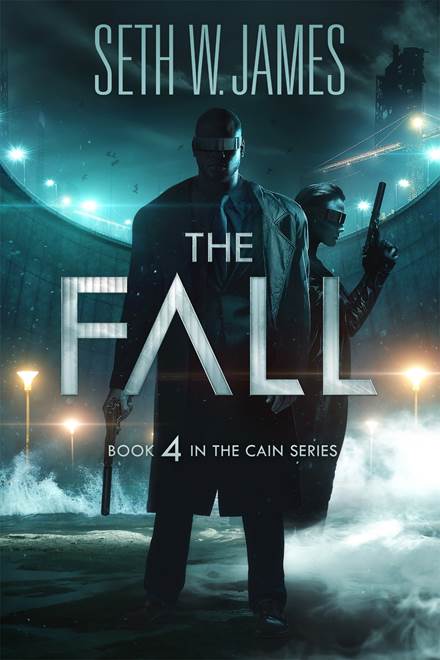
And in our rapidly enshitifying world, it is also a great comfort to know—for me and, I know, for the vast majority of readers—that James does not us so-called “AI” in the production of his covers. Just like the text inside, his covers are 100% handmade, human artistry.
The new cover for The Fall is now live in all formats, but that is the only thing that has changed about them. If you happened to have picked up the older version, well, you now own something of a curiosity; but don’t worry about buying a new copy, because the text inside has not changed.
That’s it for now. In a few weeks I’ll have an announcement for book 5 in The Cain Series as well as news on cycle 2.
Nebula Reaction: So-called “AI” and LLMs have No Place in Fiction
The Nebula Awards (and the Hugo and the Locus and the . . .) rarely attract my attention except for a few minutes the day after they’re announced, just to see if anyone I know took a prize. But with the recent controversy involving the Science Fiction and Fantasy Writers Association (SFWA) changing—and then changing back—the qualifying criteria for the Nebula, I thought I would put down a few thoughts.
The crux of the matter is, as so many things are these days, the use of so-called Artificial Intelligence and Large Language Models (AI and LLMs, respectively). The SFWA board had released updated qualification criteria for works submitted for consideration for the Nebula Awards to include those works created with the use of AI/LLMs—and, not surprisingly, artists everywhere responded with entirely justified outrage. To be clear, there is not now, nor has there ever been, Artificial Intelligence: AI remains what it has always been, a matter of science fiction. What is disingenuously marketed as AI is not intelligent and is, in fact, based on technology that has been around since the 1970s. LLMs, while less disingenuously named than AI, are largely the same thing, simple predictive models executed on a large scale through the use of datacenters (which, incidentally, are helping to worsen climate change, increase fresh-water scarcity, and raise energy prices). Both are, in essence, plagiarism devices because their databases were created by scraping content from creators, usually without notice, consent, or compensation.
A great deal has been written about the evils and incompetence of so-called AI, so I don’t feel that I need to reiterate it at length here. What I did want to address, however, was the SFWA board’s changes to the criteria, both in substance and in process.
In substance, it completely baffles me that the people sitting on the board, who I assumed were fellow artists, would condone the use of AI/LLMs in the “creation” of a work passed off as original art. As the Anthropic (or misanthropic, if we were genuine about it) case plays out, as some tiny, token compensation is paid to authors whose works were stollen, how could the SFWA board possible think that it would be okay to legitimize the plagiarism devices created through Anthropic’s (and other company’s) theft? To put it simply, the AI companies stole our work, broke them down into their component parts, and then cobbled them together to sell as if a new product. Why would any artist agree that such products constitute art, let alone that they should be considered alongside actual, human-written works for the Nebula Awards? Naturally, I have to wonder about the board members’ current and future works, if this seemed acceptable to them. That being said, it is commendable that they very quickly changed course and put the qualification criteria back to what they should have been.
In process, though, this all could have been easily avoided if the board had not taken unilateral action. For something as important as AI/LLMs and the ongoing assault on artists’ autonomy and ownership of their work, any changes to the SFWA’s policies should have been put to a vote by the entire organization. Yes, of course, the board should be able to change certain policies without the entire SFWA having to vote on it; something like when voting begins or ends or the RSVP for the in-person ceremonies are administrative matters that we expect the board to handle on their own. Policies that affect the definitions of work, from the Nebula categories to qualifying venues/markets to authorship criteria, fundamentally define the SFWA, in its purpose and identity. Such policies are statements about the organization’s beliefs and should originate strictly and exclusively from the membership’s consensus. A better grasp of the scope of their decisions is needed from the board in future.
Lastly, I think one of the causes of this mistake is the continued absence of the SFWA members’ website. After the new board was elected, one if their priorities was to overhaul and update the members’ website. It has been about a year, if I remember correctly, and the website is still down. Previously, the members’ website forum was the place where we connected and, at times, debated the issues of the day. I remember controversies about the previous board’s actions in regard to volunteers generating a great deal of discussion, as well as other topics such as TOR’s saturation in recent award cycles, new categories to receive awards, and also news around small presses that had folded and what would happen to their backlists. Without the members’ website, we have lost that virtual townhall and the discussions that had taken place there. Yes, there is a Discord server for the SFWA, but it is highly problematic: for one, access to the Discord is not automatic, members need to discover its existence themselves and then contact someone to get an invite; Discord is also crawling with state actors, is rumored to be hacked constantly by criminals, and is likely selling every word typed into it to AI companies, to populate their datacenters. So, no, Discord is not a suitable alternative and certainly not a replacement.
In closing, I would just like to say to the board that though I applaud their rapid response to artists’ outrage at the inclusion of genAI theft content in the Nebulas, it is a decision that should not have happened in the first place. Please, in future, put such important matters to a vote by the whole SFWA. And, to facilitate this and other worthy discussions, bring the members’ website back online as soon as possible.
Cover Reveal for “The Fall,” Book 4 in “The Cain Series;” Launch Date November 2025
With the cover-art reveal for The Fall, book 4 in The Cain Series, we’re just about there: two books in 2025. Here’s the cover:
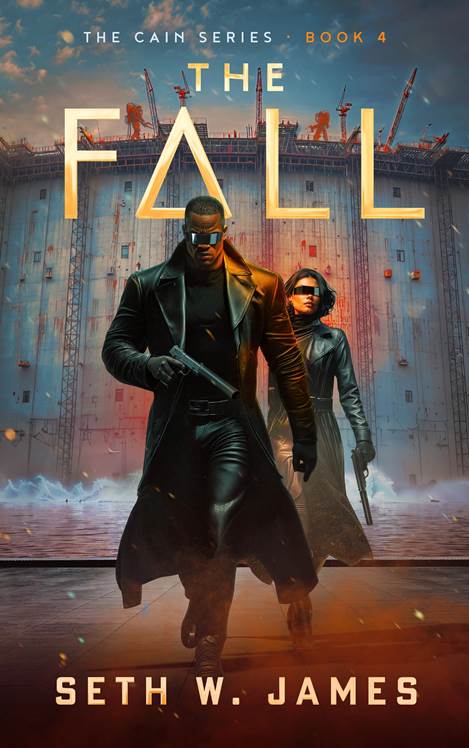
As I wrote for An Uncalculated Risk’s inclusion in Booklife’s ongoing series, Cover Crush (https://booklife.com/news/create/art-design/08/26/2025/cover-crush-striking-indie-designs-that-tell-a-story.html), growing up in the ‘80s, I loved the movie-poster style that so many paperbacks enjoyed. From the little details relating to the story, to the promise of this or that scene, those types of covers—and the covers of The Cain Series—are artworks all on their own, and not merely a colorful necessity for enclosing the text. Readers may notice, for instance, in The Fall’s cover, that Francesca has returned but, unlike her appearance on the cover for A Desperate Measure, this time she’s dressed in a dark coat and AR-enabled sunglasses, both similar to Cain’s. Hmmm, now what could that mean?
Anyway, as I mentioned in last month’s post, I did an interview with AllAuthor, which you can find here: https://allauthor.com/interview/sethwjames/
That’s it for now. We’re coming down to the finish line: only a few last assets need to come in and The Fall will be ready for the big red button, come November. Until then, happy reading!
New Novel Pre-release Announcement: “The Fall,” Book 4 of “The Cain Series,” Coming November 2025.
The Fall, book 4 of The Cain Series, will publish this November, 2025, in ebook, paperback, and hardcover formats. Like all Cain Series novels, The Fall is an episodic, near-future, cyberpunk, science fiction novel. In this latest installment, the pan-European seawall—for which Francesca had advocated throughout the previous three books—is finally under construction, but threats to its future remain. While investigating the sabotage of construction drones, she and Cain uncover a massive conspiracy that endangers not only the seawall, but everyone laboring to build it.
Back-cover copy:
“As global food-scarcity spiraled out of control, the European Seawall Project finally began constructing the massive edifice that would reclaim lands lost to rising sea levels—and upon them build the farms that would avert famine. The workers laboring to raise the seawall were provided with the very best: fusion-powered exoskeletons, excellent pay, and a perpetually hovering artificial island, where they could enjoy their off-hours near the seawall amid every pleasure and vice money could buy. Despite the urgency of their work and the joys of life on the island, not everyone was satisfied—and someone had begun sabotaging construction drones.
Francesca Pieralisi, the former prosecutor turned seawall-project director, was then sent in to identify the saboteur and his grievances. She was not given a free hand to investigate, however, nor authorized to solve whatever problems she discovered, not since Paul Devouard, ESF Chief and her boss, had lost faith in her judgement after the near-disaster of the Bolivian affair. Barred from official resources, Francesca could only rely upon herself—and Cain. Calling upon his expertise as an elite soldat de fortune, Cain enlisted the aid of his old criminal network, to cut through the misdirection and outright lies, and to uncover the truth.
Cain and Francesca soon discovered the many forces exploiting the island, from an avaricious drone corp, to corrupt private cops, to a criminal syndicate and its burgeoning underground. It was not until they began covertly neutralizing these threats, however, that they uncovered the massive conspiracy behind it all—and the atrocity central to its scheme. To save the seawall and any hope of averting famine, they must now excise the threat with a surgical strike. But will their desperate action be enough—or too much?”
With The Fall, The Cain Series’ first novel cycle nears its conclusion, as the first five novels in the series comprise cycle 1: cycle 2 will begin immediately afterward, with book 6. I wrote about my use of the episodic form and the series’ cycles here: https://www.sethwjames.com/stories-within-stories-the-episodic-form-and-novel-cycles-in-the-cain-series/
Though a darker and more tragic book than the previous three, I thoroughly enjoyed writing The Fall. The real world has, sadly, descended again into fascism, perpetual deception, and war: wading through the intentional chaos around us to find clarity, purpose, and a way forward may seem impossible, at times, but I hope that books like The Fall can offer readers a world-in-miniature, a microcosm upon which to focus and, through that mirror held up to nature, discover their own understanding. I also hope everyone enjoys the book as the kick-‘em-in-the-teeth, cyberpunk, action adventure that it is!
Book 5 in The Cain Series is already underway and I expect to publish it sometime late spring 2026. Unlike this year, though, I will likely publish only one novel next year: after completing cycle 1 in the series, I’ll need to devote the second half of the year to structuring cycle 2. It may not take too long, as cycle 2 will comprise only books 6, 7, and 8, and so it isn’t impossible that I’ll be able to complete book 6 before the end of 2026, but it’s less likely.
In any event, I’m thrilled to be nearing the end of this first cycle in The Cain Series and hope that readers returning from An Uncalculated Risk will enjoy reading The Fall as much as I enjoyed writing it.
Updates, Updates, Updates
Just a quick blog post this month. Book 4 of The Cain Series is still on track for publication this year, though August is the worst month in any kind of publishing to collaborate (peer-review, proofreading, cover creation, whatever—everyone’s on vacation; well, except me). I hope to be able to officially announce it next month.
In other news, the cover for An Uncalculated Risk was selected by Booklife for its ongoing series, Cover Crush. It should appear in the September issue. I love all of the covers for The Cain Series, so it’s great to see one of them get some love. I’ll probably wind up throwing the link to the Cover Crush issue into another post, for convenience.
In still more news, I have an interview coming out, date TBD, with AllAuthor. Not sure when that will happen, but it was fun to do. As always, I wound up proselytizing about what cyberpunk is and why it’s important, but I also pulled back the curtain a bit on my writing process, which I usually don’t, as I think writers—particularly early-career writers—get far too much advice and most of it is not appropriate for them or just flat-out wrong. I say so in the interview, so hopefully that message will come across.
Anyway, that’s it for now. My thanks to all of the returning readers who have enjoyed An Uncalculated Risk, and to new readers, too, who are just discovering The Cain Series.
Happy reading!
New Novel Pre-release Announcement: “An Uncalculated Risk,” Book 3 of “The Cain Series,” Coming May 2025.
An Uncalculated Risk, book 3 of The Cain Series, will publish this May, 2025, in ebook, paperback, and hardcover formats. Like all Cain Series novels, An Uncalculated Risk is an episodic, near-future, cyberpunk, science fiction novel. In this installment, Cain and Francesca travel to South America to uncover the monstrously wealthy force behind a mercenary invasion of Bolivia, which has disrupted their tin exports and, consequently, Francesca’s seawall project. Nothing is every as it seems, though, and the cat-and-mouse of spycraft soon escalates to armed conflict.
Back-cover copy:
“In the fusion age, war for commerce had become a commonplace. But when an unusually well-financed mercenary force seized the Alto Madidi mining complex in the Bolivian Andes, they set off a cascade of events that brought the global tin market to its knees—and threatened Francesca Pieralisi’s seawall project. Tin was indispensable to the manufacture of construction exoskeletons, called “connies,” and connies were the only means by which the seawall could be built, to reclaim the farmlands that would stave off the looming threat of famine.
To discover who had hired the mercenaries—and to determine if their goal was simply theft or an attack on EU interests—EU INTCEN tasked Francesca (and, with her, Cain) to go to Bolivia and find the truth. What they found was a plot by the richest man on Earth—or off of it—and a global extortion conspiracy involving bribery, kidnapping, and war. Francesca, undaunted by the odds, would stop at nothing to save her seawall project, but soon found herself betrayed by her own zeal, manipulated into compromising her reputation and career, and saw her life pushed to the cliff’s edge.
Cain must now fight through a web of off-world, sovereign corporations, conspiracies and counter-conspiracies, to make a lie the truth, and to pull Francesca back from oblivion. From Sovereign Trade Zones in the American South to the rainforests of South America, Cain battles not only to remove the mercenary brigade, but to short-circuit the machinations of a trillionaire in An Uncalculated Risk, book 3 of The Cain Series.”
Like Ethos of Cain, book 1 of The Cain Series, An Uncalculated Risk is told in five parts, as Cain and Francesca pursue one clue after another, hunting down those responsible for the invasion. I’ll release the cover art next month—and it’s a good one, too—followed by publication of the novel in May.
As a special sneak preview, An Uncalculated Risk will likely NOT be the only Cain Series novel published in 2025. I’m on track to have book 4 in the series ready for publication by the end of the year. Whether that means late November or early December remains to be seen; there are several factors involved, including cover creation, proofreading, typesetting, etc, and any one of them could suffer a delay. I’ll have a better idea by summer’s end and will post another update on book 4 then. For now, I’d like to say thank you to every reader who has enjoyed—and especially to those who took the time to review, always massively appreciated—Ethos of Cain and A Desperate Measure. I hope you will check out An Uncalculated Risk this May.
Stories within Stories: The Episodic Form and Novel Cycles in “The Cain Series.”
Introduction:
With the new year upon us, and with the publication of book 3 of The Cain Series coming at the end of spring, I wanted to take some time to discuss the series’ structure and format and how they might impact readers’ speculations about the series’ direction. Some readers have already reached out with their theories about what will happen next (with most people keying off of the first and last lines of A Desperate Measure), and I wanted to pour a little fuel on that fire.
The Episodic Form: a primer
All books in The Cain Series are and will be episodic, near-future, cyberpunk science-fiction novels. But what does “episodic” really mean and how do episodic novels differ from more traditional books?
At its most basic, an episodic novel is one where the story is told through a series of separate, though related, parts that add up to something more than a collection of shorter stories, when viewed as a whole. There are several different modes common to episodic fiction (as well as novels that don’t fit nicely into any), with most employing either linear—where each part follows the previous one and leads toward the book’s conclusion—and non-linear—which either tells a story out of sequence or explores a particular theme rather than combining to an overall story; either mode might also employ the same characters throughout or not.
A few familiar examples of episodic fiction may be found in the works of Charles Dickens and Alexandre Dumas. Many of the first episodic novels were the result of serialization, where Dicken’s and Dumas’s novels’ parts were first printed in periodicals, coming out over a series of months. In more recent times, Steven King used the same serializing format for his novel, The Green Mile. With serializing, each episode needs to stand more or less on its own, as readers will not have the luxury of moving immediately on to the next part of the story; so, each part needs to engender enough satisfaction for readers to anticipate—and return for—the next part. Serialized novels are typically linear.
Another classic example, which was not serialized (well, part of it was), is James Joyce’s Ulysses. Ulysses is told chronologically, though not strictly speaking in a linear mode. Though we ostensibly follow Poldy and Stephen around Dublin as they meet people and get into trouble, the book’s episodes do not tell an action-plot story (more on that to come), but rather discuss and exemplify the themes of alienation and yearning.
The episodic form is certainly not restricted to novels, of course: television shows are inherently episodic, as are some movie series. The original Star Wars trilogy is an example of an episodic series (and not simply because each movie is given an episode number in its prologue), telling the story of Anakin Skywalker’s redemption. Readers will also find the episodic form used in plays, musicals, operas, comics, graphic novels, and other media.
In The Cain Series, I employ the linear episodic form, where each part of each book follows its predecessor, but I have also further refined the form by applying classic dramatic structure to the parts, both internally and at the novel and series levels. Now what the hell does that mean?
Classic Dramatic Structure
Dramatic structure is a way of arranging the parts of a story—whether episodic or not—to make it more effective, engaging, and sensible. And whether you have received specific training in dramatic structure (e.g. a degree in literature, drama, or film) or not, you are, in fact, an expert in it—because it is used absolutely everywhere. Classic dramatic structure has its roots in ancient Greece, where plays were offerings to the gods, but is more commonly known by Gustav Freytag’s definition of the five-act structure. Freytag called the five acts introduction, rising action, climax, falling action, and resolution. I don’t know that these definitions speak as effectively to contemporary readers today as they may have in 1863, so I tend to translate them thus: in act 1, we meet the characters and maybe learn a little about the world of the story; in act 2, we learn more about the world and, importantly, the situation or problem that the story will confront; in act 3, the protagonist sets out to do something and usually hits a snag of some sort toward the act’s end (the complication); in act 4, the protagonist overcomes the complication (or not, if the story is tragic) and then, in act 5, we reach the denouement, or the wrap-up of the story.
In addition to the five-act structure, there is its refinement, the three-act structure, which we have all seen in countless movies and TV shows. The three-act is quite similar in structure to the five-act: in act 1, we meet the characters and learn what it is that they want to do; in act 2, they try to do it and hit a complication; in act 3, they overcome the complication (or not) and then wrap things up with the denouement.
Now, this may all seem pretty darn formulaic—and it is—but that does not have to mean boring. Oh, it absolutely can result in a boring story, regardless of medium: I’m sure we’ve all experienced numerous stories where we have anticipated the entire thing in the first few pages or minutes and find ourselves bored nearly to death by the tedious predictability of it all. That anticipation, which undermines us in bad storytelling, however, is the product of our expertise with dramatic structure: if we did not know how it all works, we would not anticipate it so accurately. That same expertise of ours, though, can be called upon by good writers to create tension, suspense, to inspire our imaginations as we wonder what the complication will be or how the heroes will overcome it—or not—or even if the story will have a happy or tragic ending. As with so many things in life, it all comes down to the execution.
In The Cain Series, I employ dramatic structure on three levels, with the first, obviously, appearing at the part level (levels two and three to come, a little further down). Each individual part of each book is discrete, that is standalone; they usually follow a three-act structure, though sometimes a five, and tell a self-contained story. For example, part 1 of Ethos of Cain sees Cain breaking into von Hauer’s villa on Paradise Orbital, to extort him out of stock that Lester needs to take over Arcadia Planitia, on Mars: in part 1 of A Desperate Measure, Cain tracks a stalker through a maze of streets and AI limitations.
Now, as Ethos is told in five parts and Desperate is told in three, both of these parts do not have the luxury of space that a traditionally structured novel would. Though it complicates the writing process (episodic ain’t for the timid), structuring the novels this way also produces a number of advantages, too.
Advantages of the Episodic Form
There are several distinct advantages to employing the episodic form, the first of which is speed. As every critic and reader’s review has stated, The Cain Series novels are fast-paced. This is a result of each part’s size and discrete nature, that is, its requirement to reach a satisfying conclusion within a limited space. In a five-act structured novel like Ethos of Cain, each part is roughly the size of a novelette; for a three-act structured novel like A Desperate Measure, each part is roughly the length of a novella. In both cases, each individual part needs to tell its story quickly—or I’ll run out of space. So, out of necessity, Cain Series novels enjoy a lightning-fast pacing (I say enjoy, but obviously that depends on the reader; if you enjoy fast pacing, you may enjoy The Cain Series; if you do not, you almost certainly won’t).
The next advantage is that each part of each novel is action-packed. Since each part is discrete, it comes with its own complication and resolution, and in a kick’em-in-the-teeth, cyberpunk, action-adventure story, that usually entails someone getting fucked up. And so, in each part, readers will find a corresponding action sequence. Now, writing a series of action-packed episodes does require some finesse and consideration. If every action sequence has the same level of danger, the same scale, and the same stakes, the book will quickly become tedious and predictable. Raymond Chandlier said it best, as is so often the case: “it’s like you’re playing cards with a deck full of aces: you’ve got everything and you’ve got nothing.” If, however, we go back to our classic dramatic structure for a cue, we can employ rising action, that is, increase the stakes, the scale, and the danger as the novel progresses, helping to keep the action fresh and exciting.
The third major advantage to the episodic form is the simplification of complex plots. When you have a complicated plot, such as what appears in A Desperate Measure, with a trillion-euro government project (the seawall), the avarice of a sovereign corporation (BHI), and the corruption of an official (spoilers!) raging out of control, it can often lead to the plot bogging down in the details or the readers becoming impatient with elements that do not seem terribly exciting. By taking such a plot and breaking it down into its component pieces, however, readers are only ever asked to acquire a little bit of knowledge at a time, with the rest of the prose dedicated to plot and characters. Again, for example, part 1 of A Desperate Measure introduces us to the surveillance AI and the seawall project, while focusing on Cain’s cat-and-mouse conflict with the stalker; these elements, though—the project and the surveillance AI—are fundamentally important to understanding parts 2 and 3. And so, even though each part’s plot is discrete, subsequent parts of the book benefit from the knowledge acquired in the previous parts. By the time readers come to the act 3 climax, they already possess the presuppositions necessary to enjoy it—Serval blind spots, exoskeletons, sovereign-orbital money laundering—but without ever having to slog through pages and pages of slowly-paced exposition.
There is also an additional benefit to the episodic form employed in this manner, which is seen at the book-level (the second level), rather than at the part level, and that is the melding or mingling of action- and character-driven plots.
Plots, Plots, Plots:
Though plots come in many forms and styles, they can usually be characterized as either an action-driven plot or a character-driven plot. The basics: an action-driven plot revolves around what the characters do (e.g. Cain fighting his way into a hidden research facility to steal a quantum field generator), while a character-driven plot concerns what the characters think, feel, and who they are, their identities. Most novels, regardless of format or structure, are either one or the other, though—like yin and yang—also usually contain a bit of the other. The bit of the other, though, is usually a subplot, that is, something minor that takes place alongside the main plot. In your typical romance novel, for instance, the character-driven plot is often a “will they or won’t they” plot, resolved by the protagonists getting together in some way (or not), while there is also an action-driven subplot (e.g. a terminally ill spouse, a big project at work, etc) that may act as an instigating moment for the lovers. Subplots, however, never get as much space and are never as important as the main plot; if they were, they’d constitute the main plot. Except, of course, in episodic fiction.
In Cain Series novels, with three to five discrete plots per book, a mix of character-driven and action-driven plots can be found, along with subplots involving either. Take part 3 of Ethos of Cain for an example: the action-driven plot involves Cain performing two rescue missions—Odhiambo’s and Walker’s—with their juxtaposition illuminating Cain’s character (i.e. what he will do versus what he will not); there is also a romantic, character-driven subplot involving Cain’s relationship with Francesca, about how his constantly risking his life is stressing her out, making life intolerable. But, though each of the five parts of the novel employ action-driven main plots, the book’s main plot is character-driven, a “will they or won’t they” plot resolved by Cain and Francesca discovering a way to live their two very different lives together.
And this facet of The Cain Series novels brings us, finally, to stories within stories, because the book’s plot amounts to an additional story, beyond the five stories told by the five parts.
Stories within Stories:
Though each part of a Cain Series novel tells a discrete story, it also performs a double-duty, in that each part also constitutes an act in the novel’s structure. In Ethos of Cain, part 1 tells its own story, yes, but it also fulfills the overall book’s need for an act 1, introducing the main character, Cain, and a few important facets of the world. Part 3 is also a self-contained story, while simultaneously providing the novel with its act-3 complication, which is (spoilers!) Francesca breaking things off with Cain. In part 3’s plot, Francesca’s choice to end things creates a tragic end, but in the novel, her choice creates the complication that the two of them must overcome. By structuring the parts and novel in this way, by writing Cain Series novels with multiple, discrete stories and having them combine to tell an additional fourth or sixth story (the book’s), the same exact words on the page tell multiple stories at the same time.
So, in Ethos of Cain, the parts each tell an action-driven story about Cain’s life as a soldier of fortune in the near future, while—combined—they tell a character-driven story about his identity, his sense of self, and whether he can maintain his idea of who he is, his character and dignity, while somehow changing enough to continue his life with Francesca.
The stories-within-stories told by each novel, however, go further still, in that the individual novels also play an additional role, similar to how their component parts do, by contributing to yet another, even larger story (the third level). I call these multi-novel stories “novel cycles.”
Just as each part of each Cain Series novel contributes an act to the novel’s structure and story, each Cain Series novel does the same, contributing an act to the novel cycle’s structure and story. A novel cycle, therefore, works much the same way as the novels that compose it: three or five novels taken together will tell an additional, larger story.
Now, with book 3 not due out until late spring, 2025, we have yet to see a complete cycle—but it’s on its way.
I’m sure many readers will be able to deduce the first cycle’s story once book 3 comes out (actually, a few have already done so, just on the basis of books 1 and 2), but as a little nudge to the imagination, I will say that the first cycle of The Cain Series novels is composted of the first five books; thus, each of the first five novels tells both its own story and contributes an act to the first novel cycle (i.e. book 1 is act 1 for the cycle, book 2 is act 2 for the cycle, etc). Knowing what we now know (or already knew) about classic dramatic structure, readers may very well anticipate the stories that books 4 and 5 will tell, once they have finished reading book 3 and recognize the novel cycle’s complication. We shall see.
Beyond the first novel cycle, the plan at the moment is for books 6, 7, and 8 to comprise cycle 2, followed by books 9 through 13 comprising cycle 3. That isn’t set in stone, not just yet, but as I have already outlined those cycles, it will likely play out that way. More to come on those cycles once we’ve completed the first.
Conclusion
“But, Seth, my dude, do I really have to know all this stuff about structure and episodes and all that jazz, just to enjoy these books?”
You don’t, no. This is just a little insight into how the series functions. Like any other literary technique—foreshadowing, literary allusion, extended metaphor, personification—the point isn’t to wow audiences with the author’s staggering genius (well, that’s not my goal, anyway), but to tell a great story. Just as a driver doesn’t need to know how the car’s engine is made or works, how many times the ABS pumps the breaks when decelerating, nor the revolution ratios for the differential—not just to drive the car and enjoy its acceleration, safety, and handling—the same is true for a good book: you don’t have to know that a conflict is coming up soon because of the structure; if done well, you’ll feel it anyway, in the characters’ voices, in the too-quiet of an alleyway, because nothing is that easy. If you are into literary technique, though, just like a car guy is into cars, then, by all means, have a poke around under the hood of The Cain Series. These novels are built to last.
In a future update, I will discuss the role of technology and technological revolution in the series theme—and then, a little later on, a new theme that will begin, probably with book 9. Until then, I hope you will find new and deepened enjoyment in The Cain Series and will check out book 3, this spring.
Happy reading!
What is cyberpunk?
Since the beginning of The Cain Series, a question that I often receive is, what is cyberpunk? The short answer is that cyberpunk is a subgenre of science fiction, which developed throughout the 1970s and officially began in July of 1980 with the seminal publication of John Shirley’s novel City Come A-Walkin’. William Gibson—the author of Neuromancer, cyberpunk’s most renown work—famously said of John Shirley, “he is cyberpunk’s patient zero.”
Though definitions of the subgenre abound, many—sadly, most—unfortunately focus upon the aesthetic so often found in the first, golden-age cyberpunk novels of the 1980s: rainy cityscapes with neon signs—in Japanese—punk-rock clothes and handheld computers, and maybe a tough cookie in an alleyway lighting a cigarette with a cybernetic arm. The style, however, was simply a facet of the time in which the first cyberpunk novels were written, combined with their tendency to be set in the near future. There are many other, non-cyberpunk books that employ the same style, even books that are not science fiction.
So then, what is cyberpunk and how does it differ from traditional science fiction?
Cyberpunk differs from traditional science fiction in its core conceit, the central idea around which the worlds and plots and characters are built.
In traditional science fiction, going all the way back to Mary Shelley’s Frankenstein—which was not only the first novel, but the first horror novel and the first science fiction novel—all the way through Verne and Wells, to Asimov and Herbert and, yes, to Phillip K. Dick, traditional science fiction’s core conceit is that all technological progress, regardless of any ill purposes to which antagonists might put it in the short term, is of net benefit to humanity. To say it more simply, in traditional science fiction, all technological innovation is good, even if the bad guys use it for their own selfish needs for a while: Death Stars don’t kill people, Darth Vader does.
This all-innovation-is-good-for-humanity approach is, in fact, the central idea behind Asimov’s extraordinary Foundation Series, which has gone on to inspire generation after generation of science fiction writers. From Herbert and Dick to Roddenberry and Lucas, even if technological innovation is used by bad peopled for bad purposes, the good guys will eventually recapture the innovation and use it for good.
Cyberpunk takes a different, more nuanced approach to the subject of innovation: cyberpunk’s core conceit is that all innovation—technological, social, governmental, criminal—regardless of its intended or actual benefits to humanity, will, ultimately, be exploited by the powerful to take advantage of everyone else.
The classic example of cyberpunk’s core conceit is found in the ubiquitous cyborg. The benefit to humanity of cybernetic replacement of damaged or missing limbs and organs is obvious: imagine the benefit—the joy—that such technology would bring to someone injured in a car accident or a war, to have their ability to walk returned to them. Now imagine what advantages an unscrupulous mega-corporation or criminal syndicate or fascist government could take if they used the same technology to replace the limbs and organs of their operatives, creating cyborgs so fast, strong, and heavily armored that no mere human could resist them—and then imagine a battalion of such soldiers air-dropped onto a rival’s corporate headquarters or national capitol. That’s cyberpunk.
And so, in cyberpunk—not the rainy, neon, Japanese alleyway stuff, but real cyberpunk—the novels explore the many potential innovations that the powerful might exploit. From the super-powerful AIs of Neuromancer, to the genetically engineered NuMen of Streetlethal, to the personality coding of Mindplayers, cyberpunk explores the wonders of tomorrow—and brings with them a warning.
Some readers may see a similarity between cyberpunk and Luddism: they are not, in fact, similar. Luddites reject technological innovation, where cyberpunk accepts the benefits, while acknowledging the dangers. It is one of the reasons that cyberpunk protagonists are so often masters of some tech or other: it’s how they acquired the power to challenge the antagonists.
More can be said about the obligations of the subgenre, of the frequently recurring tropes and themes, and certainly any science fiction might warn us of the dangers inherent in a burgeoning technology (which happens often, only in trad sci-fi, the blame is placed on bad humans). But the core conceit of cyberpunk—that all innovation, regardless of its benefits, will be used by the powerful to exploit the rest of us—guides the writers who explore cyberpunk’s possibilities.
Ever since an irate librarian denied my request to order a copy of Neuromancer (I was a ten-year-old with an attitude, admittedly, but I think she was under the impression that cyberpunk novels were somehow manuals for computer crime), I have been fascinated by the possibilities inherent to cyberpunk, a subgenre of science fiction that delves deeply into not only innovation, but into the human condition. Cyberpunk fascinates me as much today, all these decades later, as it ever did, and exploring the innovations of the next century, through the novels of The Cain Series, is every bit as artistically satisfying and thought-provoking as reading those forbidden novels of the 1980s. It has been a long road and a hard one, to develop the skills and experience to create the cyberpunk novels that I had always aspired to write. And it was worth every step.
Seth W. James
Cover Art Pre-Release for “A Desperate Measure,” Book 2 of “The Cain Series,” Launch Date June, 2024
Here is a first look at the cover art for my new novel, A Desperate Measure, book 2 of The Cain Series, which comes out this June, 2024.
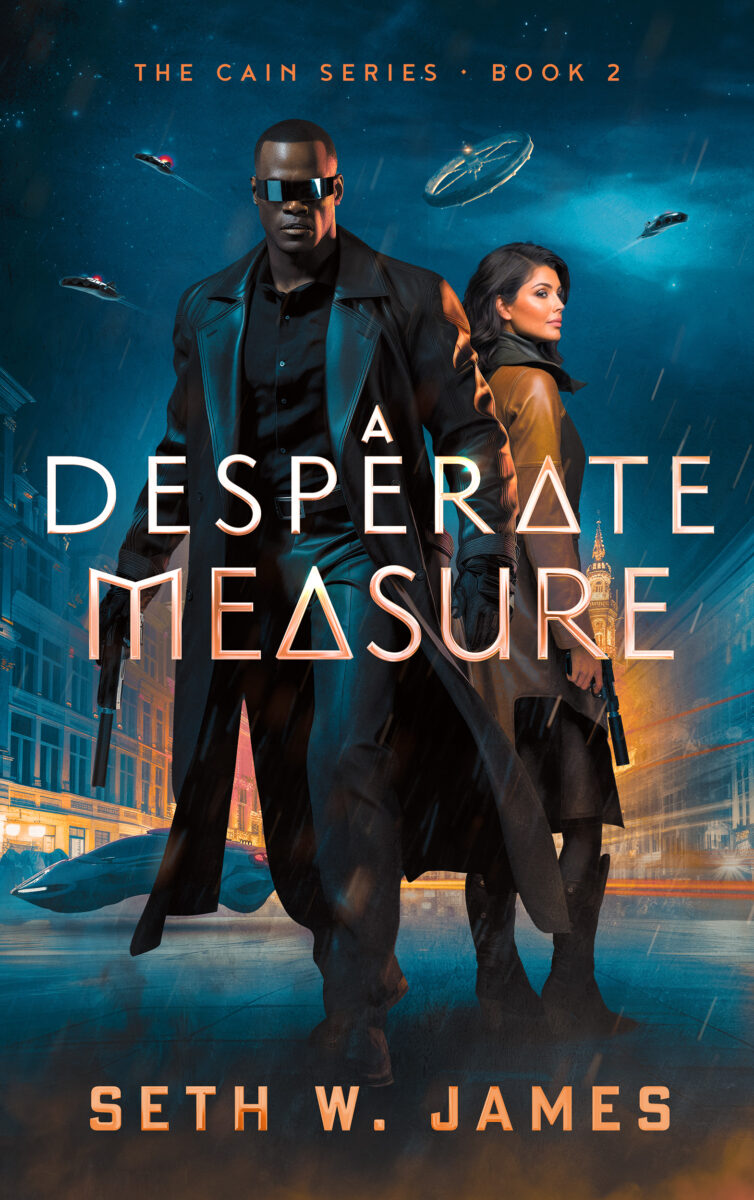
Another terrific cover from the artists at Damonza. Not only does Cain look even better than he did on the cover of Ethos of Cain, but they did a great job introducing Francesca, appearing for the first time. Francesca will likely grace some of the covers of The Cain Series, though not for every book; Cain’s adventures may require solo action, occasionally, and the covers will reflect that distinction. All in all, though, I am very pleased with the new cover art and can’t wait to see it in print.